
Sea sponges contain unique chemical cocktails that produce bacteria with healing potential
Compared to many other ocean creatures around Alaska — from sea stars to flashy corals — the Latrunculia austini sea sponge is a drab specimen. The size of a golf ball with a pitted surface, its musty green exterior allows the sponge to blend into dark environments at the bottom of the ocean. But the sponge’s unassuming appearance belies some miraculous properties. It’s still early days, but some scientists say this green sponge may offer the first real lead on fighting pancreatic cancer.
Latrunculia austini caught the attention of Mark Hamann when it was discovered in 2005 during a National Oceanic and Atmospheric Administration (NOAA) fisheries survey of the deep sea around Alaska. Hamman is a scientist who researches the medicinal properties of marine life at the Medical University of South Carolina, and he was familiar with the sponge genus group, Latrunculia, from prior research on the sponges he’d conducted in the Antarctic. After reading about the discovery in a scientific journal, Hamman reached out to NOAA biologist Bob Stone, and together they analyzed samples of the sponge.
Hamman’s excitement proved to be well-founded after the results from chemical analyses of the sponge’s tissue came back and a promising molecule was identified. “This new molecule called aleutianamine was a unique and potent selective inhibitor of pancreatic cancer and glioblastoma,” Hamann says, meaning that the molecule shows an exceptional ability to destroy those cancer cells.
Pancreatic cancer is among the deadliest forms of the disease humans currently face; the average five-year survival rate is 9%. The outcome statistics are equally bleak for glioblastomas, an aggressive form of brain tumor: the median survival rate for adults with some strains is around a year. “Options for pancreatic cancer are almost nonexistent, so in a space like that, the molecule has a much better than average likelihood of success,” Hamann says.
Sea sponges have intrigued scientists for decades. They can look like globular masses, colorful tubes, or sprawling fans; they’re the oldest true animals(multicellular, eukaryotic organisms) in the world, having lived in the oceans for around 700 million years; and they can live to be hundreds or even thousands of years old, if they don’t get eaten first. Even so, sponges have few features of something living. They have no mouths, no organs, and no digestive or nervous systems. Most of them don’t move and simply sift bacteria or tiny food particles out of the water for food. But not having the ability to move can make sponges easy pickings for certain predators, like sea turtles.
The one form of protection sea sponges dohave is their unique relationship with bacterial colonies. “Having lots of bacteria present means that sponges get to take advantage of the natural weapons used by bacteria in their own wars for space on the planet,” says Kathryn Hall, a biologist who works on sponge taxonomy and the SpongeMaps project at the Queensland Museum. As Hall explains, bacteria build colonies inside of sponges, and the sponges use that symbiotic relationship to their benefit. Some sponges harness photosynthesizing bacteria, and get a free source of food; others imbue their structures with the toxic byproducts of their bacterial guests so that hungry fish or sea turtles don’t eat them.
“Each sponge can have hundreds if not thousands of bacterial species in it, and each of those can be expressing a myriad of proteins at any given time depending on what the bacterial colony needs,” says Hall. “Chemists extract these compounds from sponges and other marine animals and check them for so-called bioactivity.”
“I think it’s certainly the best molecule we’ve ever discovered for pancreatic cancer.”
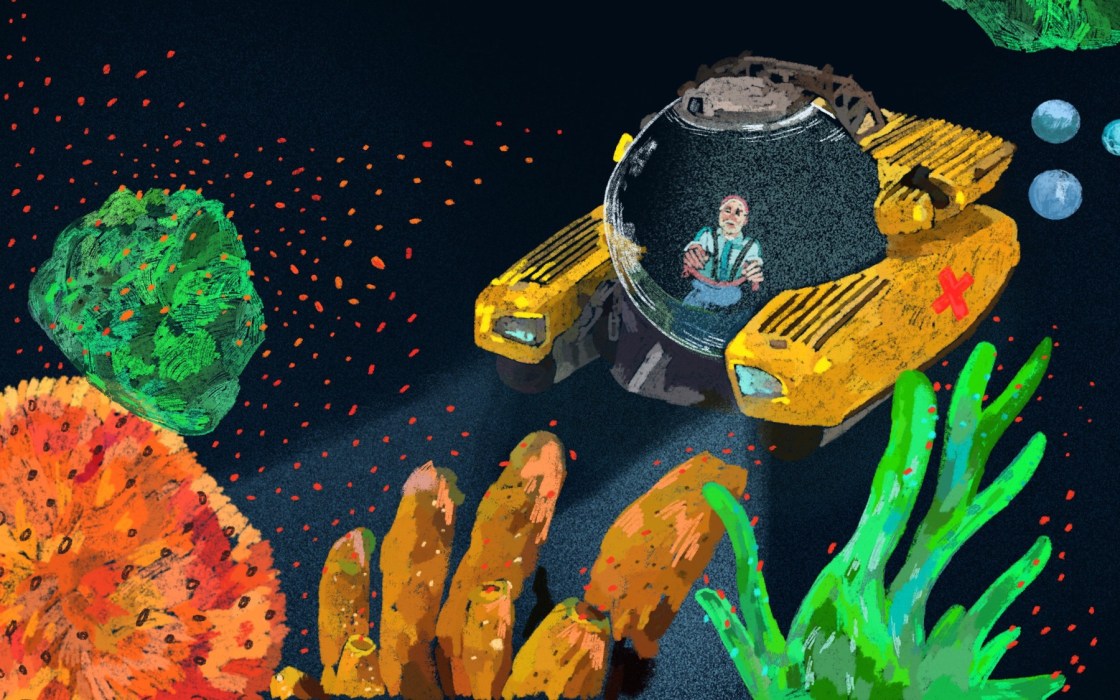
As of now, there are over 9,000 described species of sponges. They live in shallow seas and deep oceans, in perpetually warm water around the tropics and in the frigid polar waters. Hall estimates that those 9,000 species account for about half the world’s total species, which means there are still a lot of unknown sponges out there. And the detective work isn’t easy. Being underwater, scientists must either spend their time scuba diving or maneuvering submersibles to identify and collect sponges. The sponge bodies are fragile and hard to transport. Biologists often need DNA testing to be sure which species they’re dealing with, since sponges can change their appearance throughout their lives.
Still, those challenges haven’t stopped scientists from plucking sponges from the ocean to study. In 1945, organic chemist Werner Bergmann discovered an unidentified sponge off Florida. Bergmann and a colleague eventually named the creature Cryptotethya crypta. Their lab tests turned up multiple never-before-seen molecules from the sponge, including what Bergmann named spongothymidine and spongouridine. The former was similar in appearance to thymidine, one of the building blocks of DNA. Using spongothymidine as a model, scientists developed HIV/AIDS drugs that insert themselves into an infected cell’s DNA that prevent it from replicating and spreading the virus.
Scientists have since discovered sponges that might help treat the deadly infection known as MRSA, others that can treat herpes, and still more with powerful antifungal and antibacterial properties. “Every year around 5,300 different natural products and new compounds have been isolated from marine sponges,” wrote the authors of a 2016 paper in Biomolecules & Therapeutics.
Whether all those compounds and natural chemicals have practical applications is the question. Sometimes researchers are able to use the natural molecules as a model to create a synthetic drug in the lab. In other cases, experts have attempted to cultivate the sponges on aquaculture farms. In 2000, researchers discovered a New Zealand sponge called Mycale hentschelithat showed benefits for a condition called muscle wasting, which is a dangerous side effect of cancer. A research group spent several years attempting to grow the sponges on farms, but were stymied by ravenous sea cucumbers. The sea cucumbers preyed on a large portion of the sponges and made it infeasible to continue producing them in the wild.
The question of how to move forward with the Alaskan green sponge is a major obstacle for Hamann and his colleagues. The sponge is incredibly difficult to retrieve, due to the fact that it lives at depths of up to 720 feet in a freezing ocean. But even if it could be farmed, the sponges produce very low levels of aleutianamine, the anticancer molecule that scientists want to mass-produce. The challenge in replicating the compound synthetically is its tightly compressed structure with numerous interlocked rings, which Hamann says are very hard to reproduce in the lab. Hamann and his colleague Fred Valeriote filed for a patent on the molecule in late 2018, which Hamann hopes will give pharmaceutical companies an incentive to do further research, since they’ll have exclusive rights to any drug that might result from the research for its first few years on the market. In the best-case scenario, Hamann says he envisions a drug based on aleutianamine to be released in five years — but it could take up to 20.
“I think it’s certainly the best molecule we’ve ever discovered for pancreatic cancer,” he says. “Looking at the literature, it may be the best molecule discovered ever. But that’s a bold statement considering the hurdles that still remain.”
Even with the hurdles, it’s further evidence of the kinds of health benefits the ocean has to offer — and what might still be waiting to be discovered.
All Rights Reserved for Lorraine Boissoneault
 Productivity Hub