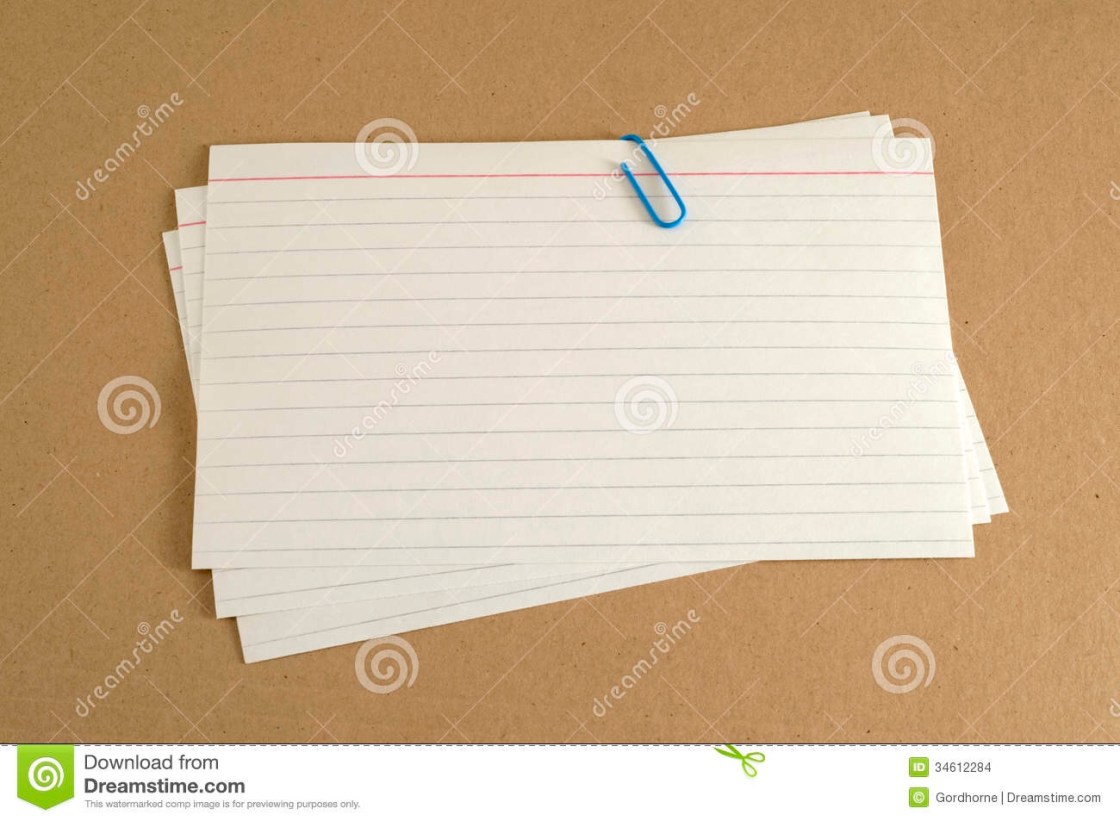
 It’s just a blank little piece of paper measuring a few inches across. And yet, it may be one of the most powerful mediums ever created.
I’m talking about the index card. 4-by-6. 3-by-5. Ruled. Blank. Colored. You’re probably familiar with the variations.
As unassuming as index cards are, they’ve managed to produce:
- the brilliant novels of Nabokov.
- the provocative documentaries of Erin Lee Carr.
- the powerful books of the strategist Robert Greene.
- the speeches of Ronald Reagan, that ended the Cold War.
- the research and theories of German sociologist Niklas Luhmann.
- the classifying and naming of all organisms and minerals by Carl Linnaeus, the father of taxonomy.
- the Oscar-winning movies of screenwriter Dustin Lance Black.
They’ve also been instrumental to me. In the course of my career as a writer and researcher, I’ve written on at least 10,000 4-by-6 inch notecards (not including daily to-do lists, which I also use them for). They’ve now served as the backbones for 10 books, and close to a million words of published prose.
A thousand hours? More?
Nearly every dollar I’ve made in my adult life was earned first on the back or front (or both) of an index card.
The only record I have are the thousands and thousands of cards, my sometimes aching hand, and possibly carpal tunnel syndrome.
Notecards are where I sketch out ideas. They’re where I record quotes that I want to save for later use. It’s how I outline my own writing and where I take notes. They’re where I jot down stories, and where I workshop points I want to make. They’ve helped me create talks and articles. They’re even where I sketch out videos and product ideas, and check the math on business deals. It’s not an exaggeration: Nearly every dollar I’ve made in my adult life was earned first on the back or front (or both) of an index card.
Everything I do, I do on index cards.
From that day forward, I began using notecards as my form of a “commonplace book”— an ancient practice — or a collection of ideas and stuff that I liked, and stuff I thought I might be able to use someday. For really long passages from books, I sometimes even type stuff up, print it, then cut it out and paste it onto a notecard. I’m an adult who owns several gluesticks!
My first book, Trust Me I’m Lying, came out of this research process. My next book sprang from the very first notecard that inspired it (which I still have), taken from a passage in Pierre Hadot’s book, The Inner Citadel. In time, more cards coalesced around it, eventually becoming The Obstacle is The Way. So too have hundreds of articles (including this one) which began when I read somewhere that Nabokov also used notecards. I wrote it down on a card of my own: “Whoa, I’m not the only one… ”
A breakthrough for me was a random box I found on Amazon: A “Cropper Hopper,” which was designed to hold photos. But for me, it was the perfect structure to form a book around. The Obstacle Is The Way is roughly 30 chapters, plus an intro and a conclusion. A Cropper Hopper has eight sections, which, by using little index-card-sized dividers, I was able to turn into 32. Each of those sections has all the material I gathered for that chapter. When I went to the library each morning to write, I only had to carry those cards to have everything I needed.
Anyway, that’s my system. But there are a lot of other systems.
Michael Crichton — the only person to have a number one bestselling book (Disclosure), number one rated television show (ER), and number one rated film (Jurassic Park) all in the same year —would collect ideas on cards until he filled a shoebox. Then on a large table, he’d rearrange his plot by shuffling the cards around until he figured out what order he wanted to tell the story in.
Dustin Lance Black uses different colored inks to categorize characters and plot points, and a long table that, when covered with cards, he knows will translate to two hours onscreen.
Bestselling novelist Jennifer McMahon color codes chapters by point of view or timeline, then thumbtacks cards to a bulletin boardto map her stories. Robert Greenealso uses color-coded cards for an extra layer of organization. With The 33 Strategies of War, he explained in his Reddit AMA, “blue cards would be about politics, yellow strictly war, green the arts and entertainment, pink cards on strategy, etc.”
Sarah Ockler, the bestselling author of six young adult novels, adds a digital element. Once she’s satisfied with an outline of paper index cards, she transcribes all of the cards into the writing software Scrivener.
From his early days as an actor, Ronald Reagan kept a photo binder of quotes, stories, and one-liners (all organized by theme) that he would use in many of his famous speeches as president. On a regular basis he would wow his speechwriters by going to the binder and pulling out the perfect piece of material for a speech, one that he had been sitting on for years. When I gave a talk at his Presidential Library in Simi Valley last year, the archivist let me hold some of them. It was an incredible experience. (There’s also a book published by Douglas Brinkley made out of them as well).
When Vladimir Nabokov died in 1977, he left instructions for his heirs to burn the 138 handwritten index cards that made up the rough draft of his final and unfinished novel, The Original of Laura. His son Dimitri wrestled for three decades over whether to honor his father’s wish or preserve for posterity the last work of one of the greatest writers of the twentieth century. Ultimately, he released them to the world, published as full-color reproductions (perforated so you can actually tear out and re-arrange them for yourself, just as Nabokov would have), “complete with smudges, cross-outs, words scrawled out… and annotated notes to himself about titles of chapters and key points he wants to make about his characters.”
David Rockefeller — the heir to America’s greatest fortune, veteran banking CEO, and legendary philanthropist —collected some 200,000 3-by-5 index cards, which he stored for decades in a specially-made Rolodex machine at his family offices at Rockefeller Center. “My effectiveness depended on my ability to develop a network of people with reliable information,” Rockefeller once said, which is why these cards are filled with details from cocktails parties, meetings, conferences, and interactions with nearly every world leader he encountered over his lifetime.
All these different uses, all these different creations, all from the same blank little piece of paper.
I wish I had some satisfying explanation about why notecards are so powerful, but I don’t. I don’t know why they are so integral (and yet used in such diverse ways) to so many fascinating people. It’s not like we’re ever taught how to use them. When I was in school, they spent years teaching us cursive, but not one minute talking to us about notecards. It’s not like they’re glamorous or displayed prominently in artsy stores and movies, the way journals are.
In fact, notecards are both boring and basic. They’re lumped together by hundreds, wrapped in cheap cellophane, then stacked unceremoniously on the bottom shelves, deep within the aisles of office supply stores. There is nothing remotely sexy about them.
But maybe that’s the point.
Creating something great like a movie or a speech or a book is a scary process. It’s an act of daring, insanity, and inspiration. Anyone that decides to build or make something from nothing needs to possess those qualities in spades.
It’s also really hard and a lot of work. That’s where notecards come in. They are building blocks, creating a foundation upon which the work can lay. They are the inches in the game of inches that is the sport of art or business.
Or at least, that’s what I’m telling myself today, as I fill out my 47th notecard and my hand is cramping, making it difficult to articulate my wrists to type these words.
Still, I know. It’s definitely going to be worth it.
All Rights reserved for Ryan Holiday
 Productivity Hub