
In a futuristic depiction, many claimed that it predicted the online target advertisement. The kind you see all over the internet that is based on your identity and your record of all online activities.

However, that scene depicted the future of advertising much more precisely than that. That movie was set in 2054 but the technology is already coming to American retail stores. And it’s even more advanced than the movie depicted.
This is facial recognition advertising.
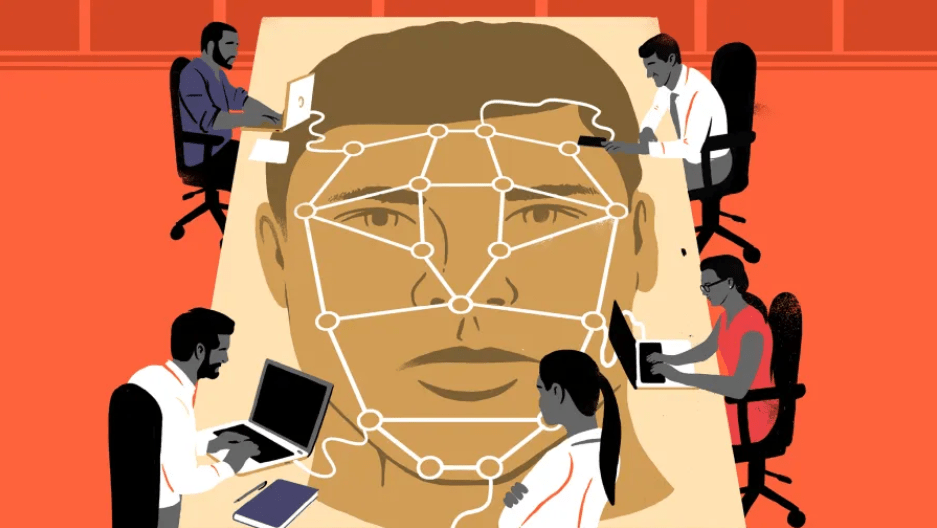
Several US retailers, including Walgreens and Kroger, are piloting facial recognition advertising in physical stores. A system that uses so-called “smart selves” can already detect your age, gender or mood when you walk by.
This technology can also track your iris movement to see where you are looking specifically. The goal is to use all available information from the cameras to target customers with relevant ads in a similar way online advertising target internet users.
When you hear facial recognition, you shouldn’t just think identification-that’s the difficult part. You should, more importantly, picture a mood detection system. Your face is a very good indicator of your emotions which allows advertisers to better tailor their ads.
Your facial expressions are often times subconscious and expose your internal reactions to certain stimuli. This mood detection is a new concept to think about it this way.
Apps on your phone can use your high definition seflie camera to track your emotional expressions of your face as you listen to music, and suggest you playlists that correspond to your mood.
A social media platform can track your face as you are typing that comment or text with your friends, and suggest you mood specific ads.
When an app like this throws an ad at your eyeballs, your facial expression can tell the advertiser a lot more about the success of their ads than traditional engagement statistics.
Emotional analytics is a way Realeyes, a startup based in London, uses webcams to measure subconscious responses to video content. Their high profile clients already include Coca-Cola, Ford, Heineken, IKEA, McDonald’s, Samsung and Disney.
Its algorithms are based off six universal cross-cultural emptional states-happiness, surprise, sadness, disgust, fear and confusion.
Curiously, even the European Union supported the company with a 3.6 million euro grant to better improve the product. This technology is also going to give advertisers an omniscient power to see whether you are actually viewing their ads, or just merely playing them in the background while doing something else.
Next generation commercials could thus require you to keep your eyes locked in as they play before continuing to your favourite content.
The ultimate point of singularity for facial recognition advertising is the ability to link your face with your social media presence. Facebook, which also owns Instagram, and WhatsApp, is going to play a major role in this area.
Let’s say you are standing in front of a smart display and you see and ad. If the AI behind it thinks your facial expressions are mainly positive about the ad and can link your face with your Facebook account, you could be delivered a discount voucher straight to your Facebook inbox. Facebook has one of the largest databases of pictures of people’s faces and the social network has been implementing facial recognition since 2011.
By the way, launching facebook’s tag suggestion feature happened totally without user consent.
Facedeals, an Atlanta based company, is testing a program that helps stores, bars and restaurants identify people’s faces through their Facebook accounts. When Facedeals learns a user’s face, its cameras will recognize them in an instant and send them to customize coupons based on their social media activity.
All major technology companies are heavily investing in the development of facial recognition, including Google, Apple, Amazon, Samsun and Microsoft. With their massive reach on the market, it will soon become extremely difficult for you to avoid being identified every step of your way if you want to be a functioning individual.
If you are worried about it, you are not alone. 75% of people say they would not shop at a store with facial recognition advertising. The same statistic also shows that 55% of consumers wouldn’t mind having their faces scanned for ads in shops as long as they get discounts.
With or without your consent, facial recognition will soon infiltrate every aspect of your life. It will become a part of a new social contract.
According to Market Research Future, the global market for facial technology has been silently making its recognition will reach about $8 billion by 2022. They into the mainstream in almost all sectors of modern society in both public and private spheres.
Japan began identifying shoppers’ gender, ethnicity and age as early as 2010. Today they moved on to identifying riders in taxis and targeting them with relevant ads.
Are free rides in exchange for your face and targeted ads the logical next step in this evolution?
The entertainment industry might also experience a radical transformation during the revolution of face scanners.
Since 2013, virgin mobile has been working on creative campaigns where users could choose from a variety of video scenes by blinking their eyes. Such an implementation of interactive storytelling could soon become its genre. Because the one man’s tool is another man’s weapon rule has no exceptions, facial recognition has its own dystopian uses.
The Chinese government is operating its massive social score ranking system, where it uses cameras to identify its own citizens and track their behaviour. This information is then used to assign each individual a trust score, which can significantly impact their travelling or job seeking options. Such a social score ranking initiative would probably cause an uproar in some of the western countries. But others are already building such capabilities.
Countries like the United Kingdom use security cameras on most urban public places, allowing the government to scrutinize movements of its citizens almost everywhere. These systems are so advanced they can identify faces even with disguises or after surgery.
In some British schools, such cameras are already being used to take attendance. Many airport terminals rely on facial recognition for security. E-passports with more ease. U.S. Customs and Border Protection in the process of installing face scanners at all national airports. US law enforcement is also deploying facial recognition to identify individuals in public by cross-referencing the camera footage with a biometric database with information on one-third of Americans.
The FBI’s technology, however, scores only about 85% of accuracy in identifying potential matches. This score pales in comparison with Facebook’s DeepFace that score 97.85% accuracy and Google’s FaceNet with 99.73% accuracy.
However, it’s not the accuracy that causes major concern. It’s the bias of the algorithm behind a facial recognition software.
Amazon’s Recognition took came under fire after it wrongly identified 28 members of the US Congress as police suspects. But what caused even more concerns were multiple discoveries that Amazon’s Recognition is misidentifying women and people of colour up to one-third of the time. Amazon continues to sell this technology commercially and to the police.
The problem is that any algorithm or artificial intelligence is going to be as biased as the data set it’s using or the programmers that are coding it.
One of the more commonly used databases for this is 3/4 male and 80% white. It is important to note that facial recognition is a system that enables classification of people by race, gender or ethnicity.
Biases against these groups implanted into the AI can result in serious discrimination. Facebook was found guilty for letting advertisers discriminate their audience based on their gender, race, ethnicity or language.
This could have been achieved by either showing ads to only specifically chosen groups by excluding certain demographics.
Facial recognition is going to allow for the same for-profit profiling but much more accurately. Advertisers will have the capability to offer customized vouchers to certain groups while excluding others whatever the motive.
Identifying individuals before they even enter a building will open the door for real life deplatforming based on what someone said on social media and there would be no way for the censored to avoid identification.
Currently, there is no comprehensive legislative plan to govern the use of facial recognition. When the lawmakers fall behind, it’s the technology that writes the rules of the game itself.
Bahio, a coffee brand based in London, once collected face of all passing pedestrians during their artificially intelligent poster campaign. 42,000 people had their faces scanned without their knowledge or consent.
In the US, only Illinois and Texas have laws requiring explicit consent from customers when collecting their faces. But on a federal level, there is no legal protection. And crafting them will be a nearly impossible task. Requiring privacy policies to be present at the entry of every store using facial recognition just puts another burden on the back of consumers.
However it will turn out to be, facial recognition in stores will remove your ability to purchase product anonymously, even if you choose to pay cash and refuse any loyalty membership cards.
Stores and brand with posters on public places will be able to track your social media accounts just by scanning your face.
Facial recognition is not an innovation for the common man. It is being developed by the elites for the elites to be used on regular people. It is, for this reason, the city of San Fransico has decided to ban the use of facial recognition by the police and other agencies.
Other proposals around the US would ban the use of facial recognition without explicit consent from customers. But they have a little chance of passing. Wherever you are, you should pay close attention to the debate and especially to how your representative plan to regulate this technology.
Facial recognition is incredibly advantageous to the ones who use it, but can also be disastrously exploitative to those it’s being used upon.
All Rights Reserved for Sid
 Productivity Hub