

Not long ago, I set a target for myself in achieving a major sales goal. It felt big, challenging, and I wasn’t sure I was going to be able to pull it off. It was a number that meant I could shift my lifestyle to something I had always wanted, and if only I could attain this number, then I would have what I needed.
If you ask most people, they have an idea of what they want their life to be, and for the vast majority they wouldn’t say they’re there yet. There’s always something around the corner. “I finally got this thing I wanted (a product, a goal, an achievement, the house…)” and then we’re on to the next thing we “need” or “want.” Humans are almost always looking to get what’s next. We strive, we push, we get what we want and head right back into the race to “success.”
Positive Psychology would say this is a result of not being grateful enough. Meditative practitioners would argue we need to be present to what is — to be centered.
Sure. I can see both of those perspectives. There’s truth there.
Seeking.
Neuroscience tells us something else. We’re flat out wired this way. Humans have a central desire to “seek.” This means that we have an internal, carnal instinct to see what’s around the corner, to dream about what’s next, and challenge our surroundings. This “seeking” nature means that we are wired, therefore incapable, of truly feeling that every desire and wish has been met. There will never be an end to goals, checking things off a list, or things we want to accomplish.

Hmmm… what’s through here? I must seek! Photo by Toa Heftiba on Unsplash
It would be like asking a person not to get mad, or sad, or happy ever again. We may be able to influence or manage those emotions, but we cannot stop the feeling.
We can’t stop the desire to seek.
…And why should we?
I hit my goal three months early. I was shocked. I felt elated, I felt proud. Within 5 minutes, my thought was — I should have aimed higher…followed by “what could I hit now?” Then I dug in to planning what I could do next.
The great thing about the desire to seek is that without a doubt it has lead to all of the great achievements of humanity. Complacency is not an option. I’m deeply thankful that our ancestors weren’t satisfied with hunting and gathering. Can you imagine what the world would be like without this desire?
So… What’s the problem?

I’ll keep seeking, but I’m also dissatisfied. Photo by Joshua Rawson-Harris on Unsplash
Dissatisfaction. Comparison. Never hitting the end of “what’s next?” Never feeling like what we do is enough.
Sometimes we are satisfied, and sometimes we aren’t. We oscillate between feeling like we’ve done enough (fleeting) and caving to our internal instinct to seek (always present).
What most humans struggle with is the desire to reconcile the need to seek with the desire to feel satisfied.
The mental shift.
If achievement isn’t the answer to any form of satisfaction for humans, then what can we do? How we frame our experience shapes our interpretation of how we make sense of the world. Our framework is the lens in which we determine our reality. If our framework is based in goals, achievement, and “things,” then we will never experience a version of satisfied.
What we need is to define a framework that both acknowledges and honors our need to seek with our desire to feel satisfied.
It’s about Growth.
What if this was the ultimate goal? If growth is the target — learning, seeking, pushing the boundaries — then the other goals become secondary without being pushed aside or diminished. Our to-do lists, our goals, our achievements are the means in which we approach and achieve growth.
Here’s why this works: we’re always growing. Seeking and growing are darn near synonymous.
Adopting the growth perspective.
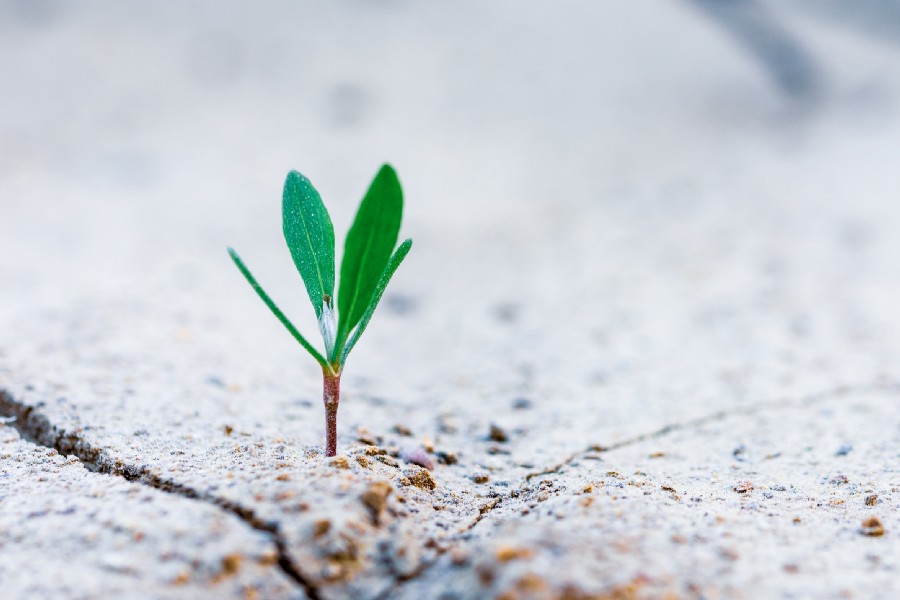
If you say ‘growth’ in an article, you have to include a picture of a sprout. It’s required. Photo by Stanislav Kondratiev on Unsplash
In her book, “The Growth Mindset,” Carol Dweck outlined the difference between a “fixed” and “growth” mindset. A fixed mindset aligns with the understanding that the world “is what it is, and I am what I am.” You either are or aren’t. It’s black and white, binary, either/or.
In the growth mindset, skills and knowledge are not stagnant, they are movable, and shapeable. Adopting the growth-mindset allows you to see possibility and to pursue — as opposed to assuming stagnation, which denies our instinct to seek, leading to dissatisfaction. A “fixed” mindset denies our internal instinct to seek. Actually embracing our ability as people to seek and grow leads to increased satisfaction, whether we achieve the outcome or not.
It’s not the achievement of the goal that satisfied our internal desire, it’s the seeking that did.
The growth mindset provides the framework to see our lives as opportunities to seek. If growth is the framework, then we can finally fulfill our lives by honoring our desire to be satisfied and to seek.

Tools on a table. But, you already knew that. Photo by Todd Quackenbush on Unsplash
Tools.
Of note and important here is Dewey’s quote: “We don’t learn by doing, we learn by thinking about what we do” (the caveat is that if we are not doing anything, we don’t have anything to think about!). This means that in order to adopt a growth mindset, we must actually stop and reflect about what we’re doing. In order to grow, we must think and reflect.
Here’s some questions to ask that can help you adopt a growth mindset:
- What can I learn from this?
- What did I learn from this action/goal/experience?
- Who can help me see this differently? What can I learn from them?
- What did I learn from those involved?
- What would I need to try in order to get better at this?
- Did I actually get better at this? How do I know?
- What would it be like if I tried a different approach?
- How is this goal or activity helping me grow?
- Who am I after this activity? What do I know now that I didn’t know before?
- What’s next?
In addition to the questions, one of the best words to start using is “yet.” I’m not really good at this… yet. I don’t know how to do that… yet. It’s a great method for beginning to see things with a growth mindset.
All Rights Reserved for Dave Newell
 Productivity Hub