
The best way to get your dream job is to write your own job description, and that’s exactly what I did when I was seven years old.
The year is 1988. Rick Astley’s Never Gonna Give You Up is unironically popular, and I’ve never seen an avocado. My salary is a humble $52 per annum in pocket money. But I have good job satisfaction, and the working conditions are great, with attractive office hours: 9am to 2pm.I just wanna tell you how I’m feeling; Gotta make you understand…
You see, school’s out for the summer and with plenty of free time on my hands, I’ve drawn up a weekly duties chart, with time blocked out for various professional to-dos.
In the morning, my first responsibility is throwing a ball down our driveway to try and hit a toy car, a variation on ten-pin bowling I’ve invented. A direct hit is worth 10 points, a glancing hit 5. I record my score and try to top the leaderboard next day: ‘My First KPI’. Other tasks include organising toy soldiers, practicing video games and managing various large-scale construction projects (of LEGO).
After close of business, it’s time for a well-earned milk break on the deck, followed by free time.
On some level, I already understand that having a structure helps me get more out of my holiday. Young Luke isn’t into ‘time management’ per se — he just wants to get the most play out of playtime.
Flash forward 21 years: Present day. Rick Astley lives on only in meme form and I have wi-fi now, but some things haven’t changed: I still want to top that leaderboard every day, and get the most out of the holiday that is life.
I want to wake up excited to tackle the day. I want time in my world for self-reflection, experimentation, and goofing off. At the same time, I want to put myself in a process that I love, and that loves me back, making me a productive, better person. I want to experience life as a video game, a cycle of more and more exciting challenges where I go after goals, win, lose, learn, experience the highs and lows, do it all again the next day, and ultimately leave the game having met real success, as far as that means loving the journey, making things happen, and sidestepping regrets. I want — in a word — flow.
Does looking at your wall calendar, timetable or (shudder) spreadsheets invite that kind of inspiration in you? Me neither. So I revisited my old holiday job from ‘88, updating it for my adult life. Pretend-pin bowling was replaced with the gym; LEGO design projects with graphic design projects and video games with… well, newer, more violent video games.
Why plan your Ideal Week?
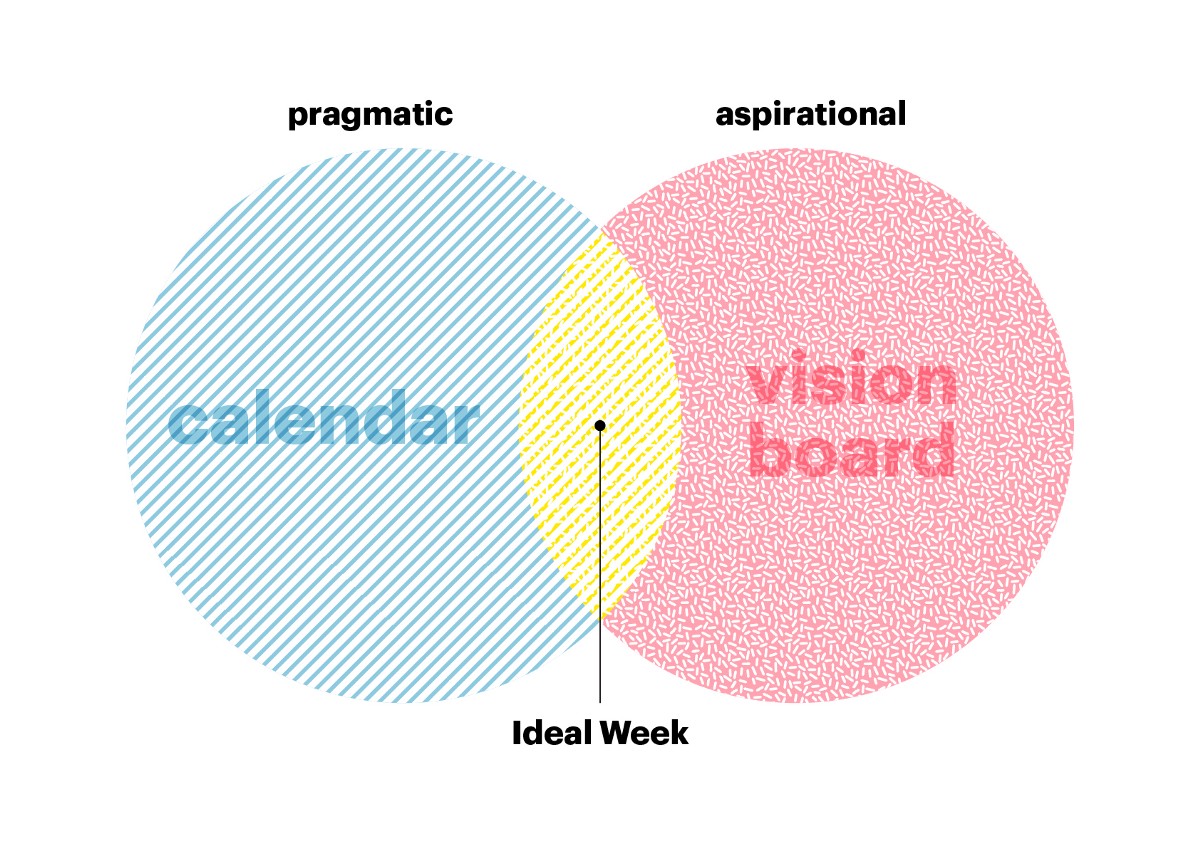
Pragmatic meets aspirational in a template for my Ideal Week.
The result was a template for my Ideal Week. It’s not my actual schedule (there are no specific events on it), and it’s not pure fantasy (it still contains a working week and mundane life stuff): it aims to live between the pragmatic and the aspirational, an interface between that lofty vision of my best life, and the reality of getting out of bed and working through my to-do list.
As a designer by trade, I’m used to the somewhat counterintuitive concept of clarifying and enforcing constraints in order to enable greater creativity and freedom. Let’s be honest: I was a weird kid; however, almost everyone, creative professional or not, massive geek or not, can benefit from an Ideal Week template that is in alignment with their lifestyle objectives:
- Make time for non-urgent-yet-important things. Many of the things we deem important are easily postponed by more urgent concerns. Imagine living life without any form of clock or calendar: you’d be constantly responding to whatever is most urgent, most in front of you. You’d be reacting to life. Having an Ideal Week in mind (and better yet, on paper) is the other end of the spectrum: it gives those important-yet-non-urgent tasks a ‘home’, so that they’re more likely to get the attention they deserve.
- Have a time budget. How do you find that sweet spot between paying your bills, saving for a helicopter and enjoying some ‘smashed avo toast’ for brunch once in a while? You make a budget. An Ideal Week is a budget for your time. How many hours should you spend exercising vs partying? Realistically, how long is it going to take you to finally finish that online course? These questions do have answers: you can balance living in the moment with designing your future, self vs tribe, work, rest and play.
- Do more of what you want. Clinical psychologist and author Dr Jordan Peterson sees planning as a way of negotiating an agreement with yourself on what you want, and what you are willing to do in order to have it. It’s not about being locked into an oppressive calendar — it’s about knowing what you want in life, and putting structures and tools in place that will help you move towards it.
- Support productivity and creativity. This is especially important if you work for yourself (and, in a sense, don’t we all?). Design heroine and one-person-studio Jessica Hische found that the lack of structure inherent in entrepreneurship, combined with her natural love of procrastination, meant her business hours expanded to engulf her entire week, prompting her to create her own ‘ultra-schedule’. Want bigger weekdays and better weekends? The Ideal Week can help with that.
- Think less, live more. Next week will be different from this week, but what’s important to you will probably be pretty similar. So there is no need to rethink every minute of your life from the ground up every time you look at your calendar. Think about the big things once, and adjust course periodically as needed.
My ideal week
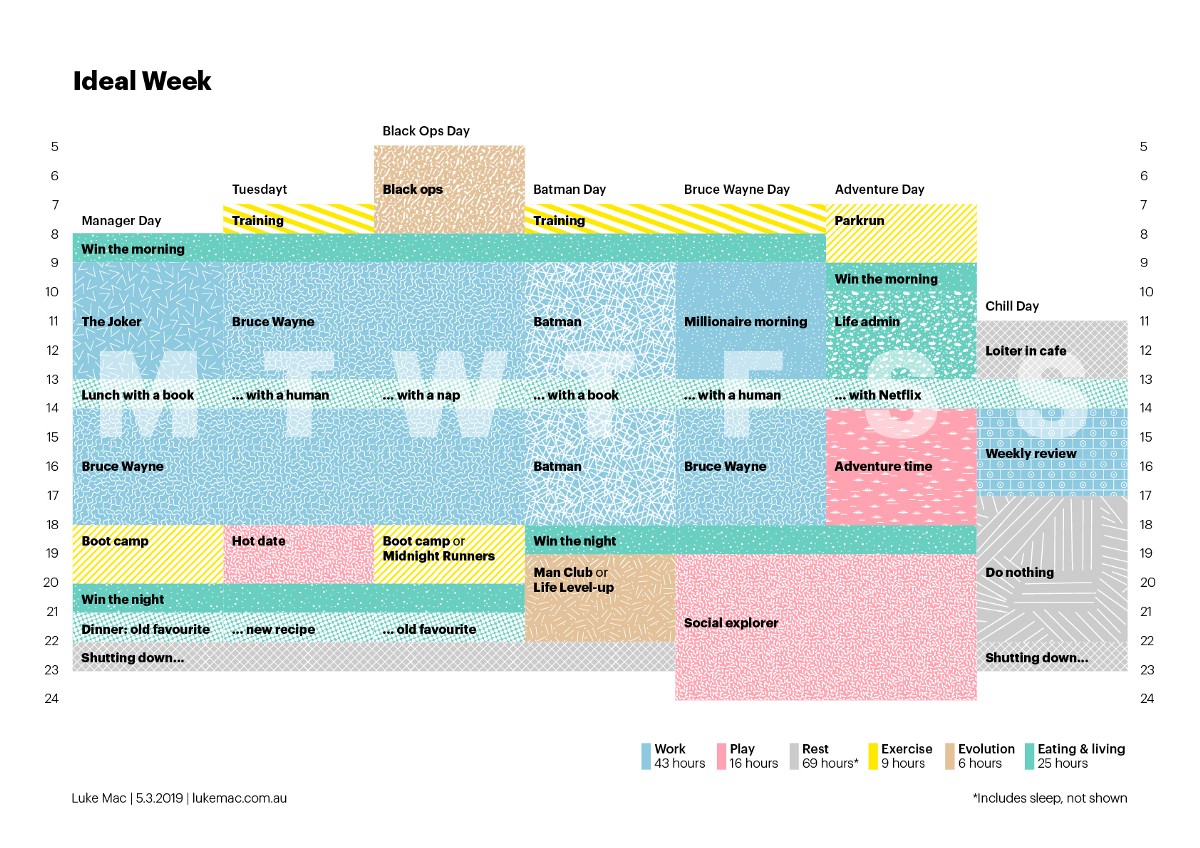
The beast itself: my ideal week at the time of writing.
My ideal week is now three years old. During that period I’ve made a lot of changes, and learned a lot by trial and error. Let’s break down my current version to pull out some delicious wisdom nuggets…
Daily themes
Taking inspiration from Michael Hyatt’s awesome Full Focus Planner, I have given each day a theme. This serves as a general intention for the day, and encourages the ‘batching’ of similar activities together, which helps with getting into a rhythm.
- Monday is Manager Day: all meetings and appointments occur on this day. This theme’s name is a nod to the Maker vs Manager concept: most of my job is making things, but I’ve deputised Monday as the day for my Manager hat. Friday is where business deadlines tend to fall, so Monday is the best place to batch this kind of less urgent work.
- Tuesday is Tuesdayt: every day should contain a garnishing of romance, but on this day the social/sexual realm is consciously made a priority.
- Wednesday is Black Ops Day: today is about paying attention to whatever special project(s) I have going on at the time.
- Thursday is Batman Day: this is a ‘school day’, but rather than focusing on the needs of my clients/employers, today is about working on the deeper purpose of my vocation, the heroic hustles, the passion projects, the redemption of Gotham City. Why Batman? Another concept lovingly stolen from Jessica Hische is the separation of Batman (the mission) and Bruce Wayne (the money) when thinking about work: do both, and be aware of which is which (these are discussed further in the next section).
- Friday is Bruce Wayne Day: in contrast to the previous day, this day is all about makin’ dat paper and helping clients.
- Saturday is Adventure Day: today is about enjoying life and doing something novel, awesome, weird and/or scary.
- Sunday is Chillout Day: today is about doing absolutely nothing, making a true art form out of leisure. I tend to follow a loose version of the slow carb diet during the week, so Sunday is also the ‘stuff my face hole with all manner of donuts and deliciousness’ day.
Working hours
As you can see from the colour key, work is where I’m spending most of my time (it’s the largest slice of the time pie after rest). But exactly what am I doing for those 43 hours?
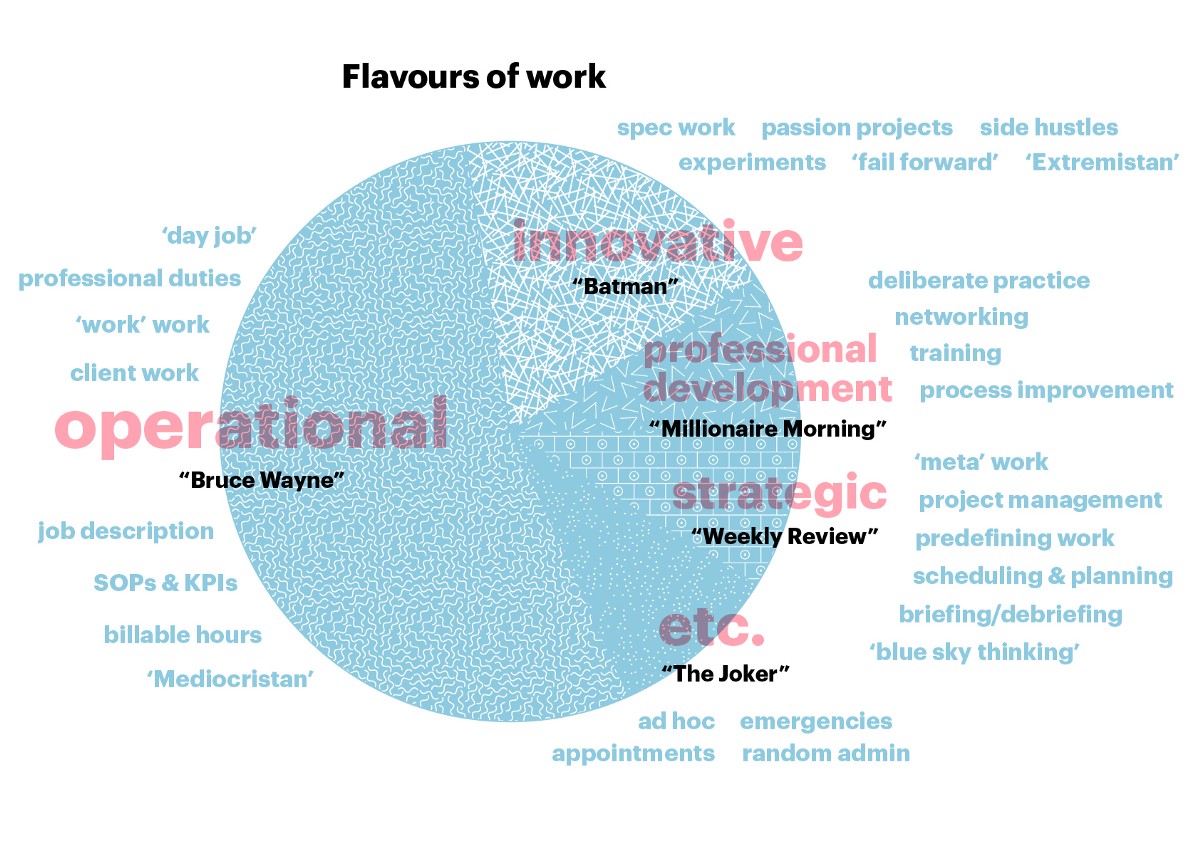
There are several ways to slice the work pie up. For my purposes, I think about strategic, operational, innovative, professional development and everything else.
I found it helpful to get more specific about the type of work I might be doing at any given time; and also to define work as broadly as possible, including anything that vaguely looks like work: if I’m in front of Penny (my MacBook), then it’s work, even if it’s my own self-inflicted ‘fun’ work.
The flavours of work are:
- Bruce Wayne: standard capital W ‘work’ — my actual day job.
- Batman: Google employees famously spend 20% of their office hours on side projects (many of which have actually become Google products/services). Batman time is this time for me.
- Millionaire morning: David Allen of Getting Things Done fame said “Don’t work only in your business, but also on your business”; this time is about strategy and improvement. Sometimes, a networking/educational event goes here, like Creative Mornings talks. At other times, it’s about improving a process, or my technical skills. This includes ‘deliberate practice’ in the form of test projects, or pro-bono mini-projects for people I like.
- Weekly review: As per the Getting Things Done methodology, this is a time to catch up on everything that fell through the cracks, empty my head and reset/plan for the week to come.
- The Joker: a ‘wild card’ for any kind of random appointments, meetings, business admin, phone calls and life nonsense like little ‘next actions’ decided upon during the weekly review (as above). The intention here is to cram all of that stuff into one nice little time envelope. Why “The Joker”? Because I’m a huge nerd — plus it’s a riff on the Batman/Bruce Wayne idea described above.
[Note: I suppose I could do the same kind of subdivision for other ‘life buckets’, too (e.g. for the ‘exercise’ bucket, I could separate durability/flexibility, cardio, and strength), but for my purposes, that approach seemed more complex than I need outside of the work domain.]
Daily routines
Routines are a great way to think less and pack good habits into an automatic ‘ritual’, for better flow. Several can be found in my Ideal Week:
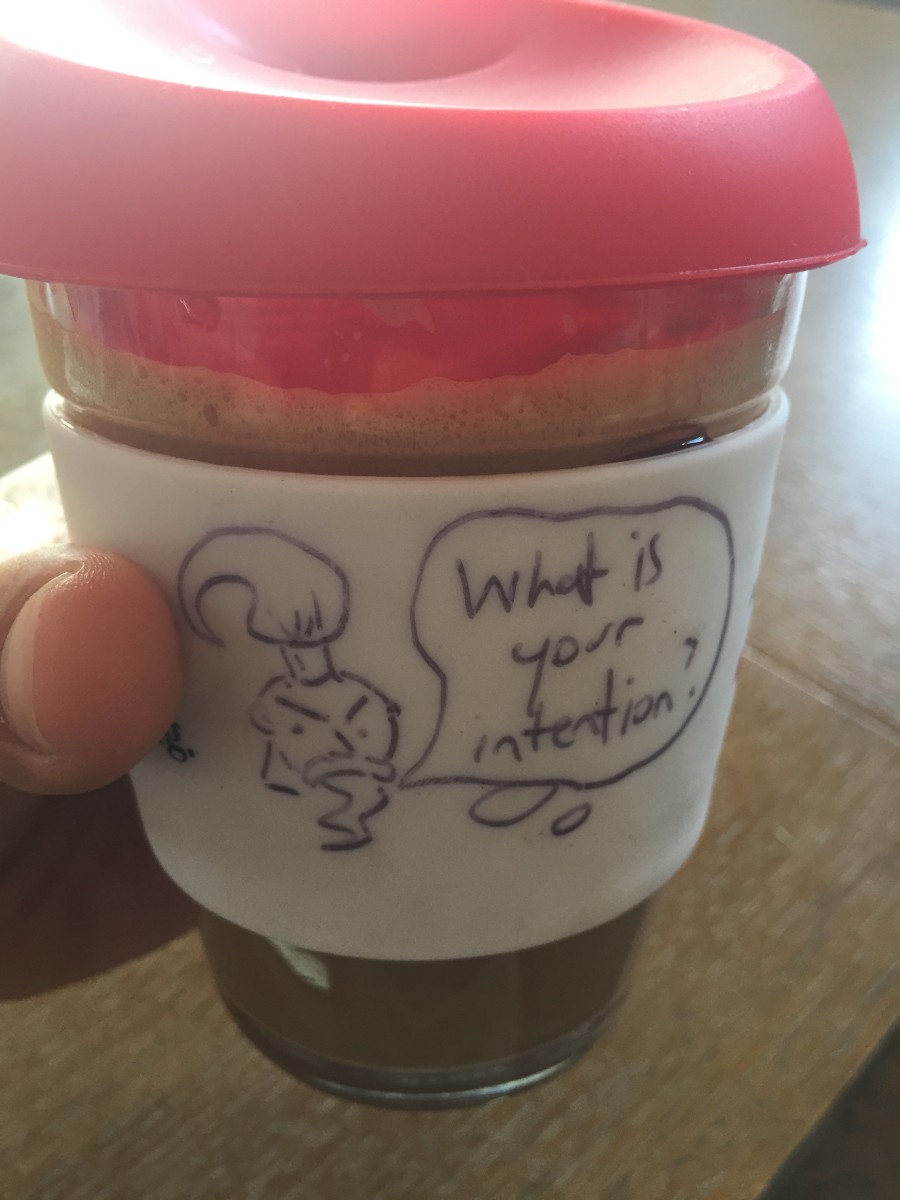
Coffee intentions: my reusable cup reminds me to start the day with the big questions.
- Win the morning: There are entire books about morning routines. The subject has been overcomplicated — the big gain is in actually having a routine. My routine is simple: wake up, get out of bed to turn off the alarm, meditate, drink a latté and ask myself: what is my intention for the day (and if I come up blank, I look to my daily theme)? Then I review my ideal week and my actual calendar to clarify daily details with myself. ‘Win the morning’ slots on my idea week also include any kind of commuting. I see commuting as a time to transition from bed/café mode to office mode, both physically and mentally. I use the commute time to meditate and maybe listen to something motivational (music, or a podcast).
- Win the night: On the way out of the office, the commute is a mini debrief time: what went well today (‘Good job Luke!’), and what didn’t (‘I forgive me, let’s fix that’).
- Shutting down: This is wind-down time to assist with ‘sleep hygiene’: during these time slots, I’m eschewing blue light (no screens), and might write about the day to empty my head. Sometimes I also play music (bass guitar) to this end, or listen to relaxing guided meditation — whatever it takes to get me to enter ‘sandman mode’. Then, there are some ‘usual suspects’: laying out clothes and such for tomorrow, flossing and brushing.
Everything else
Other time blocks of note, in chronological order…
- Hot date: As a bachelor at the time of writing, I actually would love to be spending the tale-end of every evening either on a date, or at a place where I might serendipitously collide with a beautiful single woman or two. But one weeknight in seven is a start.
- Black ops: Time dedicated to whatever wild and crazy schemes I have in progress to make my life bigger and better. I retreat into my secret volcano island base and work on my most profound plans of personal and world domination. Why ‘black ops’? The nature of the project changes month by month, so this is just a ‘black box’ bucket of time spent on the coolest possibilities of the moment (plus, it sounds badass).
- Man Club: A fortnightly meet-up with my best mates to check in on what’s happening in each other’s lives, challenge and support each other. On alternate weeks, this time is a kind of ‘solo Man Club’, where I do some kind of focused self development.
- Social explorer: Social events (and more hot dates?) tend to fall at the tail-end of the week, so Friday and Saturday nights are sectioned off for playing hard after working hard, and before resting ‘hard’ on Chillout Day.
- Life admin: cleaning, laundry, groceries, call mum, etc.
Your ideal week
Want to plan your own Ideal Week? Here’s the 5-step approach I followed:
1. Blue sky thinking
Empty your head of every consideration you have, from the pragmatic to the aspirational to the miscellaneous. I recommend a good ol’ mind map. It’s important to the process to be honest and capture everything your brain throws at you without shame or editing.
2. Highlight actionable items
To bring your blue sky thinking down to earth, take all of the things you could actually block out on a schedule and make a list. Write these out divided by frequency: daily and weekly (I also ended up with a ‘yearly’ list, which I set aside for review at another time).
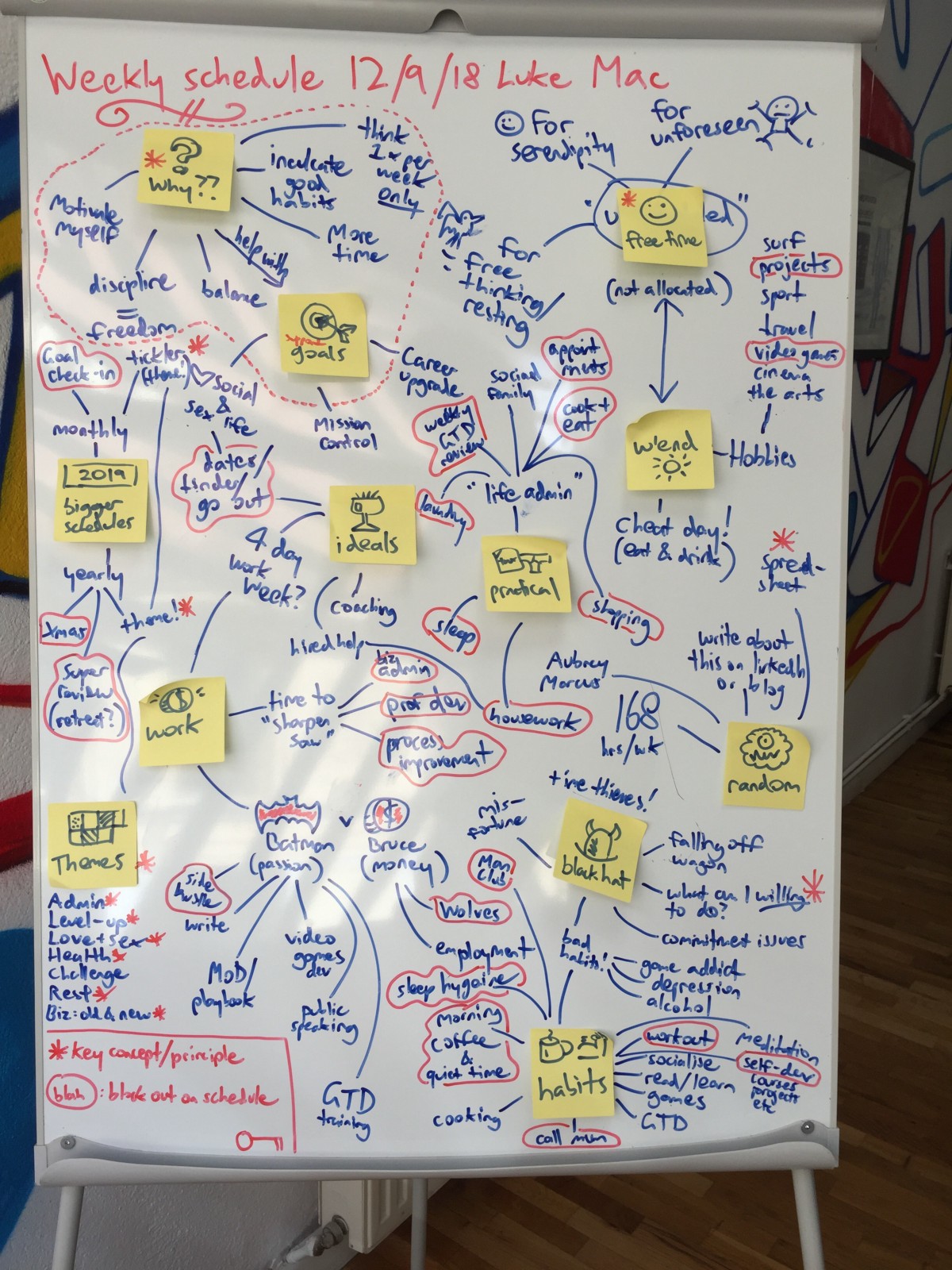
The aftermath of my latest round of thinking: everything I might want or have to do in a typical week on Earth. After brainstorming freely, I circled everything actionable in red.
3. Put items on a timetable
Use your Tetris skills to put all of the activities into time blocks. Sketch up a draft using a template, or your spreadsheet app of choice.
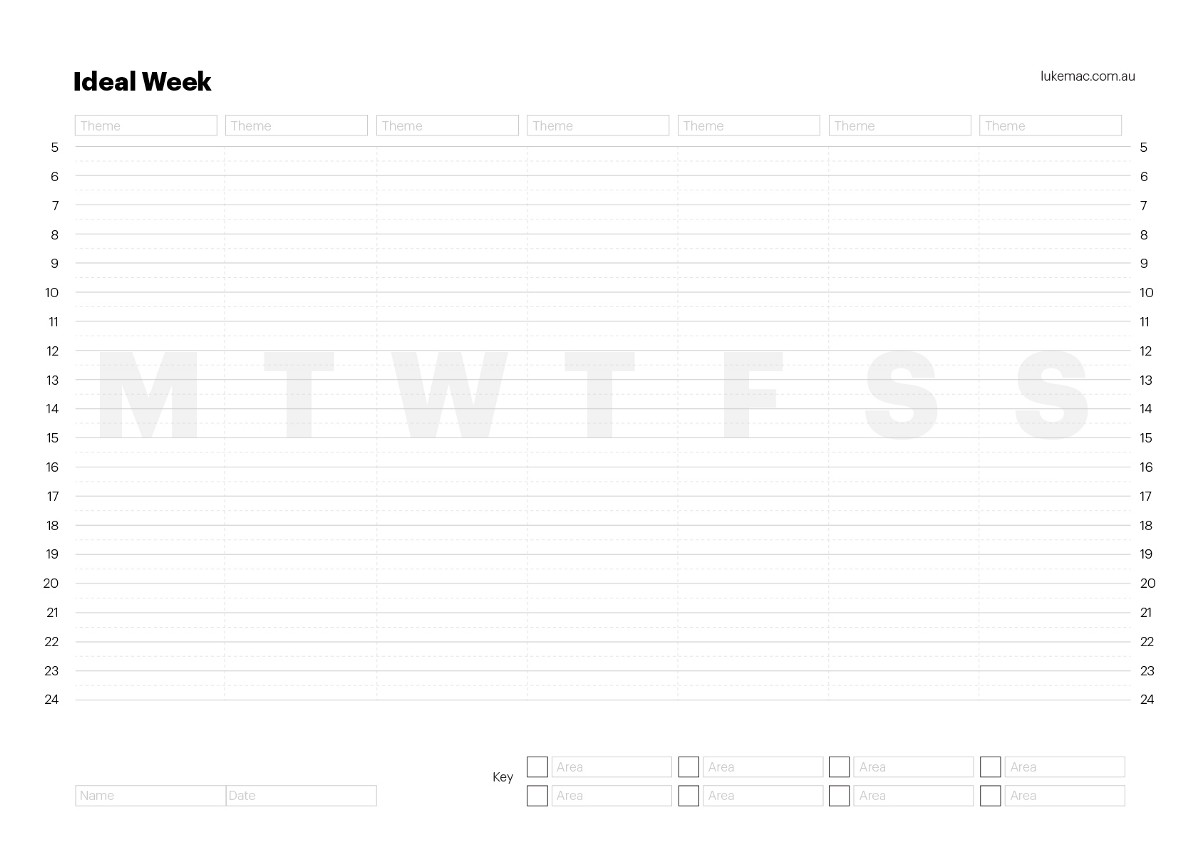
What’s your ideal week look like? Fill in the blanks: use this template or your own (or email me for a PDF version).
4. Add more awesome
Do a ‘Marie Kondo check’: once you have finished your draft, ask yourself: “Does this spark joy?”Remember: this is an agreement between you and yourself: what will you do in order to get what you want? If it’s something you’re not excited about, you might have missed something. Adjust for joy before you call it finished.
5. Execute and refine
Try it out and see if it strikes the right balance of motivating and pragmatic. Adjust over time.
Additional pro tips
- Allocate every second. Leave no unallocated time, because it’s better to have a plan you’re willing to abandon, than to have no plan. Want free time? Block that out too. Notice that I have ‘do nothing’ time scheduled for Sunday afternoon. Nothing is one of my favourite hobbies, so I’m always going to protect the privilege of ‘time-wasting’ after a hard week’s work. Besides: the better you are at relaxing, the more productive you’ll be later.
- Make it robust. Use conservative time estimates (notice that I only have hourly blocks, nothing smaller) and/or schedule in margin for ‘error’. For example, my commute rarely takes an hour. If it does, I incur no extra stress. If it doesn’t, I get bonus time. Due to personal limitations and life’s inherent uncertainty, you’re going to go ‘off script’ a lot, so don’t over-engineer things. Simple is robust.
- Know thyself. Don’t try to reinvent all of your habits in one fell spreadsheet. I used to try and do ‘black ops’ on the weekends, but I somehow simultaneously too lazy and too busy with random adventures to reliably follow through, so I’ve moved it to the crack of dawn midweek, where nothing can possibly interrupt me. My Saturdays are just too chaotic for that kind of ‘deep work’, and by Sunday I’m ready to turn into a potato for a few hours. Design for you; be nice to you.
- Manage energy, not time. More time isn’t the answer. You can’t create more time. But on the upside: Elon Musk, single mums and other people who are way busier than you are getting a lot done in the same amount of weekly hours we all have. Think about your natural energy patterns. On Friday and Monday I tend to be more motivated to push forward on work stuff. Mornings tend to be my best time for working out.
- Chunk similar things together. you’re probably more productive when you can focus on one thing at a time and get into a flow. 90 minutes seems to be a pretty solid time block for me.
Life isn’t perfect
A caveat and a confession — I’ve never once experienced the Ideal Week I’ve shard in this article. Actually, I haven’t even come close. But what I have done is increased the volume of perfect moments, those flow states at the gym on a Tuesday, at work on a Thursday or even on the sofa on a Sunday (enjoying a guilt-free “Do Nothing” session that I know I’ve earned). We’re in a constant state of refinement, and the Ideal Week acts as a practice and a compass here.
Perhaps some day, I’ll be able to extend enough of those perfect moments into a seven day stretch.
All Rights Reserved for Luke Mac
 Productivity Hub