

Why we need to understand our own limitations to avoid falling short.
What is our nature? What underlies us hairless scrawny apes?
History’s greatest thinkers have gone back and forth about human nature. Some, like John Locke, believe we are inherently good; others, like Thomas Hobbes, claim we are more malevolent. Both these thinkers arranged their theories around the state of nature, which describes human existence before the rise of social structures and government.
Locke was the optimist of the two, positing that a state of nature would be defined by prevailing freedom. Each individual would have autonomy over their livelihood because there would be no subjection to an overarching power. Neighbors would coexist rather than bicker because power would be distributed equally.
Each individual helped uphold the peace. Crime would be judged and punished by one’s neighbors, ultimately motivating every citizen to fight for peace rather than destruction. Locke claimed that preservation of mankind’s best interests would motivate behavior.
More succinctly: people would choose Good over Evil.
Hobbes was more skeptical. He viewed a state of nature as a battlefield rather than a peace landscape.
Hobbes upturned Locke’s optimism about human equality and instead claimed that, because humans are equal, anyone could dominate anyone in a state of nature. Selfishness would motivate crime and malice. Each member of society would be striving for their share of wealth and dominance, engaging in a hyper-competitive battle of self-interest.
The absolute freedom would be chaos. Death would be the price of people fighting for their own existence. Without regulations, lawlessness would ensue. Permanent conflict would be the result of man’s inherent selfishness, according to Hobbes. As the Latin adage goes,
Man is wolf to man.
Who was right?
It’s difficult to say who was “right” or “wrong” in this case. Not many people would deny feeling either selfish or generous at times. There are too many layers to peel back. Part of what makes us human are the inscrutable tendencies that define us.
I myself have never encountered anyone I would call “Evil.” Evil is an extreme. The heart of darkness. A proponent of suffering. Humans are capable of embodying Evil, as we’ve seen in the likes of Hitler and Stalin, though it seems that breed is the anomaly and not the norm.
Likewise, I cannot claim to have met anyone I consider a saint, someone unequivocally Good — the other extreme. A pure soul, untainted and devoid of suspect motivations. Jesus Christ or the Buddha may be our only historical examples.
Why is it so difficult to find a human embodiment of either Good or Evil?
The Scorpion and the Frog
Rather than agreeing one way or the other, we can look to another perspective, that of an old children’s fable.
A scorpion asks a frog to carry it across a river. The frog hesitates, afraid of being stung by the scorpion. The scorpion argues that if it did sting him, they would both drown. The frog considers this argument sensible and agrees to transport the scorpion. The scorpion climbs onto the frog’s back and the frog begins to swim. Midway across the river, the scorpion stings the frog, dooming them both. The dying frog asks the scorpion why it stung him, to which the scorpion replies “I couldn’t help it. It’s in my nature.”
Both the scorpion and the frog reveal whispers of Locke and Hobbes’s theories of human nature. The frog represents the well-intentioned neighbor, willing to lend a hand. An all-too-trustworthy comrade willing to see the good in someone, despite glaring warnings.
The scorpion represents a being who, despite their best efforts, succumbs to their nature. The scorpion acts out it’s compulsions, despite knowing that in doing so, he is literally killing himself.
The old tale tells us that, despite our best efforts and intent, we often fail to repress our nature. We behave as our nature urges us to.
Our behavior is rarely one-dimensional. The actions we take almost always have multiple motivations, conscious or otherwise. We often act impulsively even if it dooms us because, as the scorpion said, it’s in our nature.
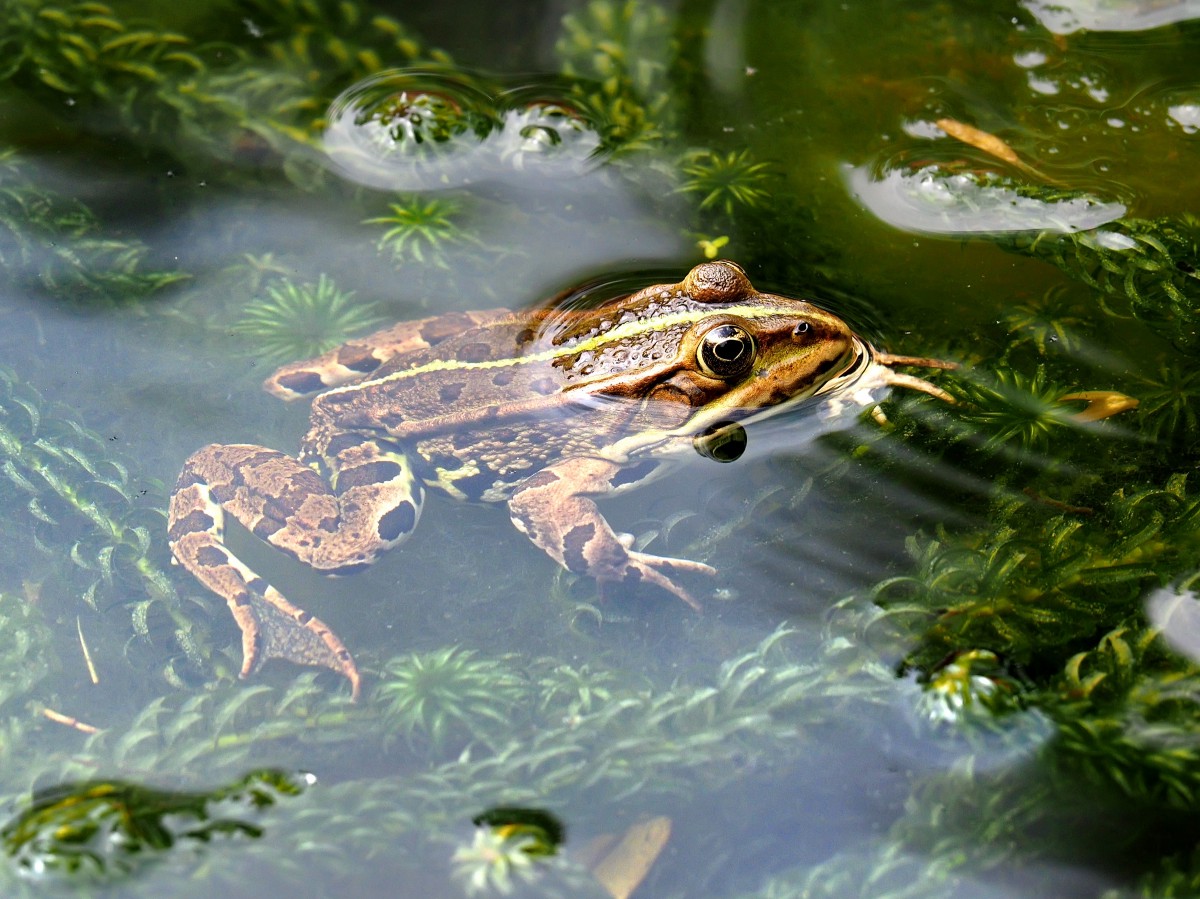
Locke the Frog and Hobbes the Scorpion
The ideas of Locke — the more optimistic philosopher — is echoed by the trusting, agreeable frog.
The frog teaches us to be aware of the nature of others, and act accordingly. We don’t always have to be so trusting, but sometimes if we are, it can bring out the best in others if we provide the chance.
Though the scorpion killed himself and the frog, it was the frog who granted the scorpion the opportunity to act for the Good. The opportunity stemmed from the frog’s trust in the scorpion.
Maybe the frog should have acted more prudently by denying the scorpion a river ride. To judge someone based on their worst quality tends toward nihilism, though it is also pragmatic and can keep us safe. Nonetheless, the frog chose to act, to try and see beyond his assumptions.
The frog’s choice reflects the human tendency to see the Good. We can choose to give someone a chance in spite of their glaring shortcomings.
The scorpion aimed to be Good. It was in his own best interest to do so. But, even when death was the cost, the scorpion could not counteract his own nature. The frog knew it; the scorpion knew it. He acted just as he was supposed to act.
The scorpion’s actions reminds us to know our own nature, as well as our own limitations.
If we know ourselves to be vulnerable to a certain temptation, avoid the situation. If we realize we have no choice but to succumb to a poor choice, change the context. Alcohol, drugs, sex, crime — the allure of vice is strong, and it’s only in our nature to be drawn to it. But by knowing, realizing, our own nature, we can take action and prevent our own demise.
Just as the scorpion could have chosen to not put himself in a situation where he would kill the frog and himself, we too have the ability to choose the situations we expose ourselves to. If we are conscious of our own nature — our own inability to repress a vice or sin — we can take action to create the best outcome.
The Takeaway
Aleksandr Solzhenitsyn said it best, echoing the moral of The Scorpion and the Frog,
“The line dividing good and evil cuts through the heart of every human being”
It is impossible to define humans as Good or Evil entirely. There are too many variables. Too many conflicting motivations.
Recognizing our own nature can help us act properly.
We must recognize it not to concede to it, but to learn how the choices we make can determine the amount of Good we manifest.
All Rights Reserved for Phil Rosen
 Productivity Hub