

Decision making is not easy but that’s what a leader has to do all day, every day.
Even if you’re not leading a team in an organization you can still apply these techniques in your daily life with your friends and family.
We’re going to cover two ways to come to a decision. One is to listen to everyone and then make a decision. The other is to let the team decide.
Both of these approaches have their pros and cons and both of these ways are valid and applicable in different scenarios.
At the heart of decision making is information. There are different ways that information can flow within your company.
We’ll look at the pros and cons of different ways to control and distribute information and how they affect decision making and vice versa.
Decision Making Without a Center
In this model, the leader supports the team in coming into their own decisions and helps them to carry out those decisions.
For example, when there is a conflict between two teams and they come to the leader for a resolution, the leader can step back in the meeting so that the team members can sort it out.
Giving ownership of the decisions to the team empowers the team which increases accountability.
People are usually happy to have the leader make the decisions because it lets them off the hook and they feel that they don’t have to take accountability.
The feeling is that if the decision goes south then the team is not ‘responsible’. But this creates an unhealthy dependency on one person. If the leader is not available, it creates confusion and idling.
By taking ownership of decisions teams perform better. Because there is buy-in from the team, they are apt to take charge. They are more motivated to try to find a solution because everybody feels like it’s their idea.
Distributed decision making also contributes to personal growth. When there is a sense of ownership people tend to stay back longer to finish the work even if they are not asked to. This has a direct impact on the speed at which work gets done. Deadlines are pulled in as the average velocity of the team increases.
Distributed decision making cultivates the leaders of tomorrow. One of the most overlooked aspects of leadership is to groom people to be leaders themselves. When the team feels empowered, the chaos factor goes down.
If your actions inspire others to dream more, learn more, do more and become more, you are a leader.
-John Quincy Adams
Top-Down Decision Making
Top-down decision making does have its place in many projects. Projects, where the leader holds expertise in a particular area can benefit from a top-down decision-making approach.
Distributed leadership in this type of projects can put an undue burden on the team members. Without proper training and education team members should not be expected to make critical decisions that have an impact on the project schedule and budget.
Sometimes in a distributed decision-making model, there can be conflict among different team members. The conflict can come from different people having different ideas.
Sometimes different departments have different tools and metrics to measure progress and those different metrics overlap in a way that can create conflicts.
When the team can’t come to a resolution after a few meetings, the leader should step in with an answer without any more meetings, and close the issue.
When the team can’t come to a resolution, the leader should step in with an answer. The answer should take into account both parties’ point of views. The leader should be transparent in why and how they came to their decision. The decision should address the concerns of both teams in a way that they don’t take it personally.
Information is at the heart of making any sound decisions. After we discuss the flow of information and how it affects the team and the leader, we’ll discuss the picture below to understand what it means for a leader to operate in each of these four quadrants.
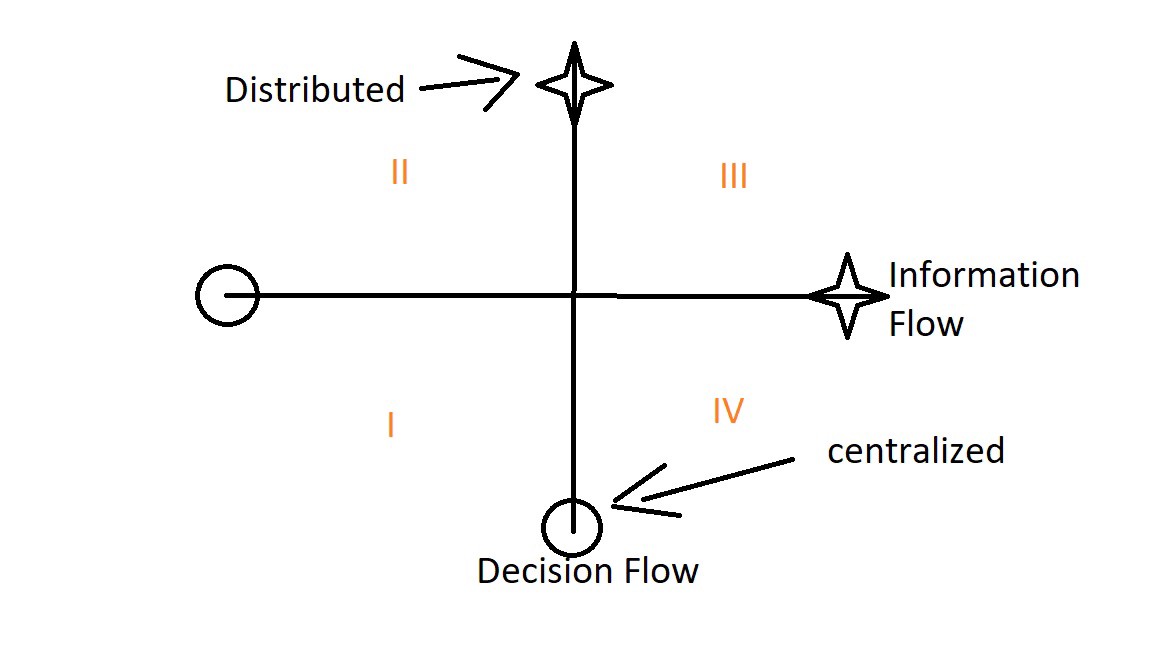
The Axes of Decision and Information: Image by Bivas Biswas
Information Flow
Information flows differently in a top-down model versus a distributed model.
Top-Down Information Flow
In a top-down model, the leader will usually gather information from different sources and then decide who to share the information with.
On many projects, not everyone needs to know about everything. If the scope of the project is big then it is not possible and practical for every department to know about the details of what other departments are working on.
There is usually plenty of tasks in each department that if they just focused on their own tasks, it might still be difficult to pull things off by the deadline. In cases like this, the leader should be vigilant about teams getting distracted by information overload.
Information flow control is necessary for projects that have regulatory requirements. Some information is not to be disseminated to individuals without certain security clearances. When I worked on US Defense projects which were ITAR controlled, control of information flow was essential and a necessary part of the job. We all had enough information to get our jobs done, and it worked.
Distributed Information Flow
In a distributed model anybody can share any information with anyone. This can foster learning from your peers.
Sometimes team members are more apt to learn from each other than asking questions to the leader. Since peers usually are going through the same problems and are facing similar predicaments in solving the problems, they can easily relate to one another.
In a top-down model, sometimes team members can also hesitate to ask questions to the leader in fear of looking stupid or not being considered good enough for the job.
These can create problems that can fester under the surface for a long time. Usually, these problems will eventually blow up on your face.
This can usually be solved by arranging peer reviews.
The leader needs to make themselves available for the team members, initiate communication, and ask questions that can bring issues out in the open.
An approachable leader doesn’t always mean that team members will approach them to discuss issues. Some team members will sense the leader’s approachability and will feel safe in discussing problems while others will try to cover up issues.
Team members who are not transparent or have issues with authority would like to keep the leader at an arm’s length. Their fear is that the leader will find out that they are incompetent even if they are not.
In such cases, it can be difficult to gauge the situation by asking questions as the answers will usually be tailored to what the team member thinks that the leader wants to hear.
The leader will need to keep an eye on schedule slippage. Team members like these tend to share some common attributes — they’ll be short in their answers, they won’t necessarily participate actively in decision making, and will usually complain about things, or grudgingly give in to what’s being decided. A word of caution: these factors by themselves mean nothing. The leader needs to evaluate these behaviors in the proper context.
The Quadrants of the Decision and Information Axes
The circle represents centralized decision making and controlled flow of information. The star represents the distributed model.
If a leader operates in quadrant I, it means they make the decisions and they control the information. This can work in situations where a high degree of control is needed like in the army. The mission is defined. The leader needs to push young people to perform. If the project doesn’t necessarily require operating in quadrant I then it might mean that the leader is having trouble letting go of control. The leader, in this case, may need to practice doing less and learn to delegate more.
Quadrant III — This quadrant is the polar opposite of quadrant I. A leader operating in this quadrant will have a strong sense of delegation. A common fear of leaders operating in quadrant III where decisions and information are distributed can sometimes be that of feeling left behind or losing touch with the project and the team. The leader needs to remind themselves that operating in this quadrant requires faith and reliance on the team to execute the mission whereas the leader provides the support needed to clear obstacles for the team.
A leader will need to shift around to different quadrants depending on many factors that can include nature of the project, deadlines, who is on the team (novices or experts), size of the team, regulatory requirements for data and/or sensitive nature of business intelligence, etc.
Navigating with a Steady Culture
The way information flows through the team doesn’t have to be imprinted into the culture. It is beneficial that it be not part of the culture because it can change while the culture needs to remain consistent.
Different projects require different ways of dealing with information flow and sometimes the same project can benefit from moving the marker one way or the other depending on schedules and budgets.
There needs to be an underlying constant under this change. That constant is the culture. When there is a lack of culture, then moving the information flow marker can make some team members nervous about their job situation.
It is the leader’s job to sense the nervousness and try to remedy the situation so the team can continue to feel safe and stay motivated in their positions.
For example, the leader can communicate the need for the change in the flow so the team understands that it is not a new culture that’s being adopted rather just a tool that the leader is using to benefit the whole team.
In Summary
We looked at two aspects of leadership- how to make decisions and how to leverage the information flow within a team for success.
We talked about situations where different types of decision-making approach, as well as different ways to flow information, can benefit the team.
I have seen productivity soar in multiple industries under good leadership when the right techniques are applied in the right context.
Making decisions and keeping everybody on the same page all the time can be hard. Fortunately, there are tools that the leader can leverage to help them along the way that can be both empowering, and ultimately, productive.
All Rights Reserved for Bivás Biswas
 Productivity Hub