
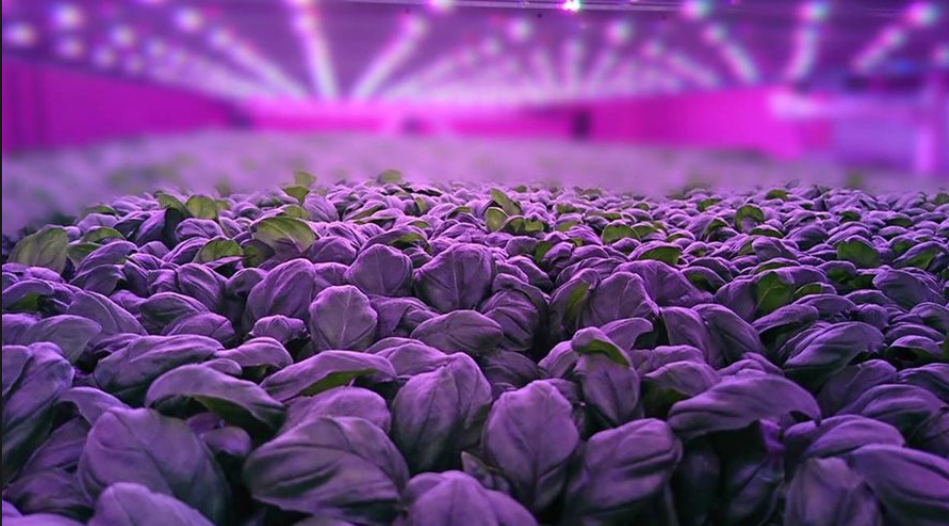
Agriculture is essential to our existence and the sector is coming under increasing pressure to reduce its environmental impact. However, with the population increasing it will be under greater stress than ever before. We will need to feed 9 billion by 2050, with 70% of that in urban areas (Al-Chalabi, 2015). This will mean that by 2030 we will have ⅓ of the arable land that we had in 1970 (Benke and Tomkins, 2017). Previous agricultural revolutions have relied on chemicals to increase yield, at the cost of the planet (Besthorn, 2012). Now is the time for sustainable technology to lead the next agricultural revolution.
Vertical farming presents a solution, despite being a relatively new technique. Vertical farming grows food in a totally controlled climate that is automated to deliver the exact temperature, amount of water and light to the plant. Soil based farming occupies 38% of the Earth’s land (Kalantari, 2018), but by building up, vertical farms have a 30 times higher yield than traditional farms, of the same area.
This concept was popularised following the 2011 tsunami in Japan, where 5% of the countries farmland was lost in the first hour. Vertical farming was identified as the best strategy to optimise what land was left. The technology has the potential to feed 60% of the urban population by 2030 (Kalantari et al., 2017). Discovering ways to feed the urban population is particularly important as they have less access to fresh food, due to farm locations (Besthorn, 2012). Just as we built up to solve housing demands, we must do the same for farms.
Currently, the vertical farming model is being used in a number of places around the world. In China it is used to farm pigs, in New York basil and in Singapore fish. Singapore also grow 10% of their leafy greens in cities, using vertical farming technology (Benke and Tomkins, 2017). The technology is becoming more widespread as it develops and its benefits become clearer.
One of the main benefits of vertical farming is that it minimises waste in a number of areas. 70% of the Earth’s freshwater is used in agriculture, but much of this is lost through evaporation or run-off, where the water drains through the soil rather than being taken up by the plant. By working in a controlled environment and using AI, it ensures the plant is given the exact amount it requires and it is all taken up.
Another benefit of farming in a controlled environment is that pesticides become redundant. The crops are also not vulnerable to drought or other extreme weather events (Kalantari, 2018). This means that the crops are resilient to the effects of climate change.
Beyond yield and waste, vertical farming benefits the wider ecosystem. With less land required for farming it means, land can be rewilded (Kalantari, 2018). This will help to increase the biodiversity and capacity for the land to hold more carbon, helping slow climate change.
Finally, due to the smaller area of vertical farms, more food can be grown locally, especially in urban areas. This reduces the environmental impact from transportation and lowers the price of food.
However, as with anything there are still challenges facing vertical farms. Due to the fact that the climate is totally controlled, it is a very energy intensive process. So, at the moment is only viable for small greens, in areas with lots of sunlight (Al-Chalabi, 2015). Strawberries are slowly becoming viable and the first potatoes are being tested. The technology is still in its infancy, but is rapidly developing. The cost of vertical farms is also high, as land in urban areas is expensive, creating a high start-up cost (Benke and Tomkins, 2017). This initial cost alongside the cost to run means that vertical farming is not yet widely adopted.
Additionally, there is a stigma against food that is grown in vertical farms (Al-Chalabi, 2015). It is seen as less natural, but ironically it is the most organic, as it is grown in a totally controlled environment, with no need for chemicals. Until people become more comfortable with the idea of consuming food grown indoors, it will not be the first choice. For this to be rectified there needs to be more information given out about the process. This could potentially be done through visits to farms, showing people how it works and the results from it.
Vertical farms still have a long way to go, but with time and development of technology they can become a solution to the current problems with farming. More trials are needed to test the potential of vertical farming and more research is needed to develop its capabilities. Further, those in the agricultural sector will need to be offered retraining, to ensure their livelihood is maintained (Benke and Tomkins, 2017).
Vertical farming has the potential to fix the problems currently associated with the agricultural sector, but it remains to be seen whether that potential will be realised.
All Rights Reserved for Alex Canal
 Productivity Hub