
When you abandon traditional diplomacy, you get dangerous situations like the one that’s unfolding in Kashmir
Throughout the course of the Trump administration, the United States has traded grandstanding outbursts for traditional diplomacy, choosing to pick squabbles with rival world leaders rather than engage in the at-times monotonous pursuit of international relations. And a number of diplomats and foreign policy experts contend that as a result of that hubris, the word is a much more unstable place.
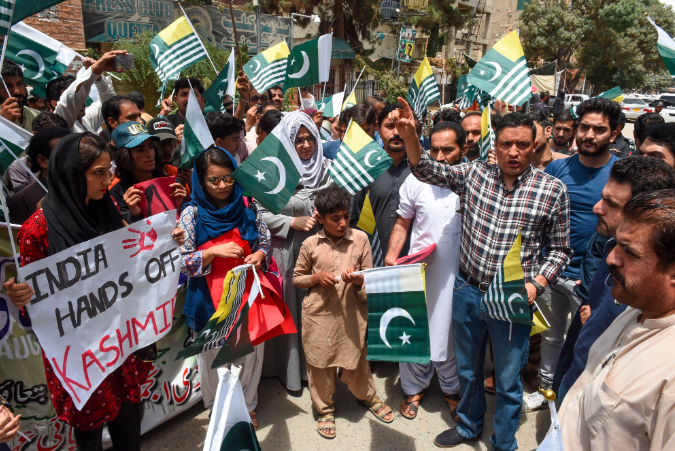
The White House’s foreign policy agenda leaves multiple key issues completely unaddressed through normal diplomatic means, opting to instead focus only on matters that directly involve the president’s interest and involvement — for example, tensions with Iran, the trade war with China, and a nearly singular effort to denuclearize North Korea. For everyone else, the United States has resorted to “absentee landlording,” according to a senior diplomat from a NATO ally who spoke to GEN on the condition of anonymity. The drawbacks to this approach are perhaps most clearly seen in Kashmir, where on Monday the Indian government officially drew back the state’s autonomy.
“The Americans, in terms of foreign policy and national security actions… are largely absent and seem to have no policy at all on critical subjects such as continued democratization in the Balkans, the continuing nightmare of a potential conflict between India and Pakistan over Kashmir, and the condition of human rights around the world,” says the NATO diplomat. “The things Trump cares about by tweeting are incredibly complex issues that he wants to reduce [to] sound bites. But what’s just as alarming are the areas where the president lacks any real interest.”
That assessment was backed by a top diplomat from the Obama era, who, speaking to the New York Timeson Wednesday, argued that the daily hands-on approach to diplomacy that Trump continuously rejects would act as a serious counterweight to regional problems.
“Without the steady centripetal force of American diplomacy, disorder in Asia is spinning in all sorts of dangerous directions,” said William Burns, a deputy secretary of state in the Obama administration and now the president of the Carnegie Endowment for International Peace. “The net result is not only increased risk of regional turbulence, but also long-term corrosion of American influence.”
“By publicly disregarding diplomats and experts, Trump is running the risk of standing by while tensions like those in Kashmir escalate dangerously.”
According to Paul Musgrave, an international relations professor at the University of Massachusetts, Amherst, Trump consistently delivers on one campaign promise: to ignore traditional diplomacy in favor of personalized arguments to American exceptionalism.
“From stepping away from the Paris climate change agreement to questioning NATO, to tweeting scornfully about other leaders, Trump has made good on that promise — if we understand ‘greatness’ as doing what makes the U.S. look decisive and self-interested in the shortest of terms,” Musgrave says.
This approach marks a shift from the near-constant level of diplomacy pursued by U.S. officials for the past 70 years, Musgrave adds. And while the watchdog approach of former administrations certainly had its drawbacks, it also helped stabilize some parts of the world and solidified the role of the United States as a major international player.
Half a dozen diplomats and experts contacted by GEN cite the situation in Kashmir as evidence of an absence of United States leadership. As tensions continue to escalate following India’s push to further discriminate against Muslims in the region, offers of mediation from the United States — which arrive following a period of relative disengagement from the nations involved — are seen as useless or even counterproductive.
“Whatever [India Prime Minister Narendra] Modi took away from his meeting with President Trump at the [June 2019] G20 in Japan, it must have included a bit of thinking that Trump didn’t understand Kashmir and would not take actual steps to reign in some aggression,” says the NATO diplomat. “It’s hard to see this behavior happening under the pressure that would have come from Obama or Bush.”
Musgrave adds that any inaction on the part of the United States also creates an opening for another nation to act as a peacemaker, creating a potential hitch in the future of the United States as a widely trusted superpower.
“By giving up on diplomacy and publicly disregarding diplomats and experts, Trump is running the risk of standing by while tensions like those in Kashmir escalate dangerously,” he says. “Alternatively, by creating a vacuum, Trump could be letting other powers step in to play the U.S. role of mediator, which will lead the U.S. to become even less involved with the world.”
All Rights Reserved for Mitchell Prothero
 Productivity Hub