
How this so-called affliction became a rallying cry for liberal elites who want to tax the hell out of themselves
By the time it was over, I half-expected a squad of cheerleaders dressed in Eisenhower-era outfits to charge out and exhort the crowd with an old-timey call-and-response: “Gimme a T! Gimme an A! Gimme an X!”
Instead, the two-day gathering of self-described Patriotic Millionaires in Washington D.C.’s Mayflower Hotel ended with a boozy salute.
“A toast to taxes!” shouted John Cavanagh, head of the D.C.-based Institute for Policy Studies, to the hundred or so attendees who’d made it to the bar after two days of speeches, presentations, and glad-handing. “To our love of taxes!”
Wearing a “Tax Me” pin on her jacket, the woman next to me raised a glass of pinot noir from Oregon’s B-Corp A to Z Wineworks (“Aristocratic wines at democratic prices”). I would have clinked with her but I was too busy scribbling notes with the “We Love Taxes” ballpoint pen I’d picked up earlier in the day, one of several pro-tax tchotchkes handed out over the course of the event.
Aside from military contractors, it’s rare to find a group of Americans so openly besotted with the idea of taxation. What made this collective of tax-friendly citizens even more remarkable is that all of them reside within a wealth bracket that offers all sorts of tax advantages, and for whom multifarious tax-avoidance schemes have become a kind of government-sanctioned shell game.
In late June, about 200 extremely wealthy people convened in a hotel ballroom a 10-minute walk from the White House to attend a pair of back-to-back conferences. On Monday, The Hunter Gathering — named for David Hunter, the “godfather of the modern philanthropy movement,” who died in 2000 — was a combination kickoff dinner and liberal symposium on the future of philanthropy. From battle-hardened ’60s-era crusaders to a younger generation of social justice warriors, speakers emphasized the need to change the broken “Charitable Industrial Complex,” which they asserted often serves as PR cover and a sophisticated legal tax dodge for the über-wealthy.
Aside from military contractors, it’s rare to find a group of Americans so openly besotted with the idea of taxation.
On Tuesday, the D.C.-based liberal think tanks Economic Policy Institute (EPI) and Institute for Policy Studies (IPS) co-sponsored a daylong “Taxing the (Very) Rich” conference featuring a roster of notable speakers and discussion panelists. Economist, New York Times columnist, and progressive hero Paul Krugman delivered the morning keynote address. “We turned ourselves away from a plutocratic society once (after World War II) and we can do it again,” he assured an early-arriving audience. In the afternoon, Nickel and Dimed author and activist Barbara Ehrenreich opened her talk with the greeting, “Thank you for being class traitors!”

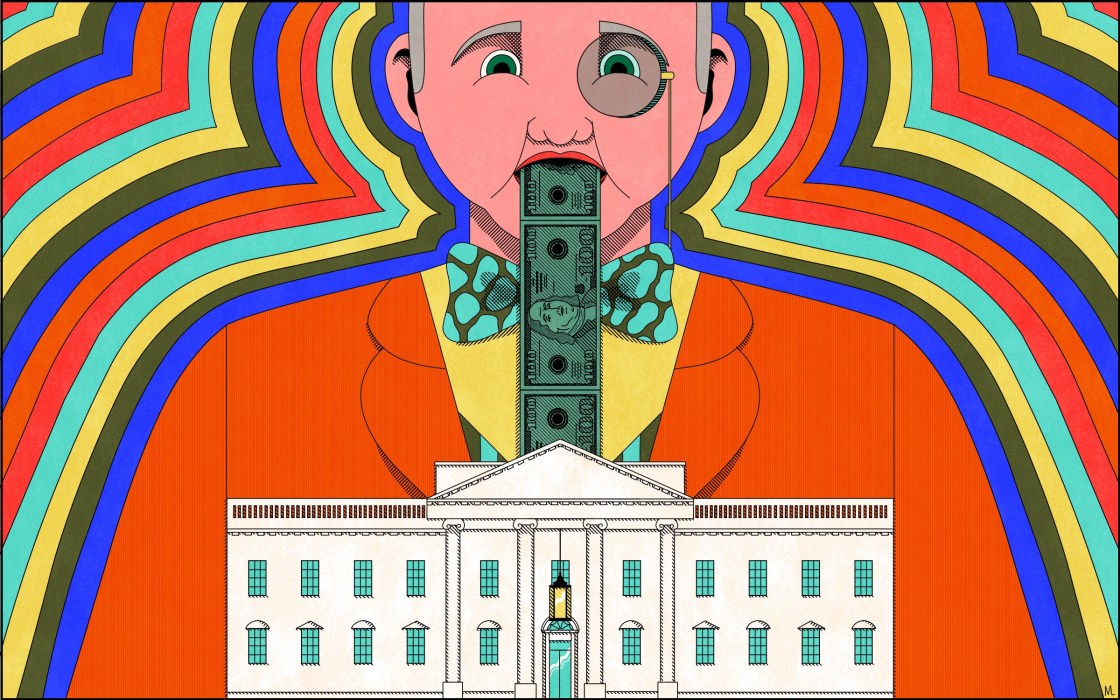
But the most cannily crafted and attention-grabbing piece of the program was something called Excessive Wealth Disorder, or EWD. More than 20 speakers from around the country came to advocate for various tax-policy proposals under the rhetorical mantle of this newly christened national affliction. Broadly defined as a range of societal, economic, and political problems and dangers created by extreme concentration of income and wealth in the hands of a fraction of society — the now well-known .1% of the top 1% — EWD describes not so much a personal pathology as a societal disorder.
Wandering through the hotel’s windowless, 4,300-square-foot ballroom for two days felt a little like bearing witness to a Givenchy-clad seed planting for an improbable political movement. The rich — at least an increasingly vocal minority of them — are revolting. But in an unexpected way. They’re agitating for policies that will directly diminish their own wealth and power. Their pitch isn’t based so much on self-righteous morality or civic duty — though there was enough of that on display over the course of the event — as it is on self-preservation.
“Policies that create gross inequality in our society are not good for regular Americans and are also not good for the rich,” said Patriotic Millionaires co-founder Chuck Collins. The economic apartheid created by worsening wealth and opportunity gaps, he believes, is leading to a country so riven with dissent, poverty, and intractable social ills that soon no one will want to live in it.
We are the wealthy, the Patriotic Millionaires came to the nation’s capital to say. We’ve been getting away with murder and we’re not gonna take it anymore.
The man who coined “Excessive Wealth Disorder”
Founded in 2010, the Patriotic Millionaires are, according to the organization’s website, “high-net worth Americans, business leaders, and investors who are united in their concern about the destabilizing concentration of wealth and power in America.” The group’s organizing principles are support for progressive taxation, increased minimum wage, campaign finance reform, and reducing the influence of money on politics.
The organization is chaired by Morris Pearl, a former Blackrock executive and retired Wall Street financier. Members, who number about 200 and qualify by providing tax returns showing assets over $1 million, include billionaire medical-device heiress Pat Stryker, investor Lawrence Benenson of Benenson Capital Partners, and corrugated-cardboard magnate Dennis Mehiel.
One of its more public-facing members is a quixotic 71-year-old named Alan Davis. Davis personally hosted and underwrote The Hunter Gathering, throughout which his graceful manner and generous nature were lauded by a string of well-to-dos who took to the podium between drinks, crudités, canapés and the fish, steak, or vegetarian dinner option. Tan, tall, fit, and effortlessly affable, Davis is known by friends for a subversive sense of humor and an affinity for puns and wordplay.
“Welcome to the Billionaire Bash. You can take that any way you like,” he says, opening the event on a decent laugh line. “I myself am a conflicted poster child for Excessive Wealth Disorder. I woke up this morning and couldn’t decide whether to wear a Brunello Cucinelli T-shirt or an Armani suit. I decided to go Armani.”
Davis is originally from New York. His father, Leonard, founded the Colonial Penn Group of insurance companies in 1963. After graduating from the University of Southern California in 1970 with a degree in business administration, Davis became interested in a variety of political and social causes. He was particularly drawn to recycling efforts.
In 1976 he founded the Conservatree Paper Company, which in the 1970s and ’80s became the country’s leading distributor of recycled paper. In 1983, Inc. magazine named Conservatree one of the fastest-growing companies in America. But pressure from the biggest players in the paper industry eventually forced it out of business. Conservatree closed as a going concern in 1995, and was later re-established as a nonprofit organization with a recycling education and advocacy mission.
Since then, like his mother and father in their later years, Davis has devoted much of his time to philanthropy and liberal political causes, with forays into other business ventures. He’s lived in San Francisco — not the Bay Area, downtown San Francisco — for almost 50 years. This makes him pretty much the malevolent specter your imagination is supposed to summon when conservatives raise alarm bells over the San Francisco radicals out to turn the United States into Venezuela Jr.
“I myself am a conflicted poster child for Excessive Wealth Disorder. I woke up this morning and couldn’t decide whether to wear a Brunello Cucinelli T-shirt or an Armani suit.”
Davis coined the phrase Excessive Wealth Disorder, which made its first public appearance in an opinion piece he wrote for, of all places, Fox Business in March 2019.
“With income inequality at record levels, underfunded government programs, and unprecedented political and philanthropic giving, the excessively wealthy have outsized influence in vital parts of civic life,” Davis wrote in Fox Business. “They influence who gets to run for office, what issues are discussed, and how Congress votes. They shouldn’t.”
Because the ungodly rich have so effectively insulated themselves from the concerns of everyday Americans, goes the argument, their policy concerns increasingly reflect a set of values anathema to the rest of the country. Because their children need never attend public school, they don’t care about funding public education. Because they’re more likely to get to their next meeting on a private jet than a bus or subway, they neglect public transportation. And so on and so on, until you’re putting Central American kids in cages along the border, homeless tent encampments blight major cities, student debt hamstrings another generation, the national anthem and Betsy Ross’s flag become symbols of divisiveness, and you’ve got more NHL franchises in the Sun Belt than in Canada. Nobody wants this.
Davis initially had a tough time convincing his fellow liberal elites to embrace the EWD handle. Several of the conferences’ 22 partners — including the EPI, IPS, and Americans for Tax Fairness — found the name corny and feckless.
“They like using straightforward clichés, like ‘Tax the Rich,’” Davis told me. “The problem is ‘Tax the Rich’ doesn’t suggest an exploration of the full range of pernicious effects of excessive wealth, and doesn’t have the call to action that a disease has.”
Davis’ stubborn insistence on EWD was vindicated when Krugman sanctified the term in the headline of a New York Times op-ed in the days leading up to the conference.
“Extreme wealth really has degraded the ability of our political system to deal with real problems,” Krugman wrote. “The wealthy, on average, push for policies that benefit themselves even when they often hurt the economy as a whole. And the sheer wealth of the wealthy is what empowers them to get a lot of what they want.”
Full disclosure: I first met Davis in 1998 in the lobby of the Hilton in Port of Spain. I was in Trinidad covering Carnival for a travel magazine. Davis was in the midst of a global working vacation planning the launch of a publishing house specializing in travel guides aimed at the wealthy. In 2002 and 2004, his now-defunct Greenline Publications put out my two-volume set of books documenting relics and extant traces of battle at World War II sites around the globe.
When I began a book project last year (for another publisher) that in part examines how the wealthy commute ideas of status and prestige on the popular imagination, I called Davis. After assuring me he still resided “comfortably within the 1% though nowhere near the .1%,” he invited me to the Hunter Gathering and Tax the (Very) Rich conferences.
“Why haven’t we taxed rich people since Reagan lowered the rates? It’s because those promoting fair taxes have fallen into two traps,” Davis said in Washington D.C. “The first is making taxes so complicated. We debate the merits of one loophole versus another, we try to explain what a carried-interest loophole is, we scare people with proposals that opponents claim will cost them their jobs.”
“The second trap is conflating the 1% with the .1%. There is a huge difference in the circumstances of someone earning $400k versus $2 million. Even the difference between $1 million and $2 million is significant. We should stay focused on the excessively rich, starting with those earning over $2 million per year. There should be a pledge — no new taxes before the top .1% pay their fair share.”
So, what is that fair share?
The Patriotic Millionaires’ favored plan for taxing upper-echelon rich and narrowing the income gap is to impose a 10% surtax — on top of all existing taxes — on all income and wealth over $2 million. According to Josh Bivens, director of research at the EPI, this would raise $75 billion in the first year alone. “That gets you enough to make a serious investment in children under five” and fund a lot of other programs as part of a “full-bore progressive agenda,” Bivens told attendees.

A key to the surtax is that it would apply to capital gains earnings as well as income, a feature absent from many tax plans.
“Most rich people earn their wealth through investments, and are rewarded with a significantly lower tax rate on their earnings for doing so,” Davis says. “Rather than working, they invest their wealth to work for them, and they end up paying a lower tax rate than what most middle-class Americans pay on their income.”
Although the Patriotic Millionaires were founded almost a decade ago on the idea of tax reform for the wealthy, the organization now finds itself within a growing tax-the-bastards ecosystem.
The most infamous proposal has been Democratic Representative Alexandria Ocasio-Cortez’s call for a 70% marginal tax rate on all income over $10 million. Not so much a detailed plan as a proposal made within the context of the vaunted Green New Deal, the 70% proposal hasn’t made a serious dent in debates among Democratic presidential contenders.
Under Senator Elizabeth Warren’s Ultra-Millionaire Tax plan, households would pay 2.1% on all net worth of more than $50 million and 3% on all net worth above $1 billion. Warren says her plan will haul $2.75 trillion into the federal treasury over a 10-year period. Many economists have disagreed, saying the take will likely be far lower.
Senator Bernie Sanders is more focused on the intergenerational transfer of wealth. His For the 99.8%Act would introduce an estate tax with rates up to 77% for inheritances of more than $3.5 million. According to his campaign website, Sanders would also “substantially increase the top marginal rate on income above $10 million.”
At the other end of the spectrum among Democrats, Joe Biden’s more modest Biden Plan would “roll back the Trump rate cut for the very wealthy and restore the 39.6% top rate,” according to his website, and “assure those making over $1 million will pay the top rate on capital gains, doubling the capital gains tax rate on the super wealthy.”
The beef pushed by millionaires against billionaires is actually part of a global trend. In her 2012 book The Plutocrats, journalist Chrystia Freeland — now Canada’s Minister of Foreign Affairs — traced the roots of the contemporary rich-vs.-richer fight to the 2004 Orange Revolution in Ukraine, a series of public protests against government corruption. While university students and western Ukrainians angry with the government’s pro-Russia policies formed the heart of that movement, Freeland and Swedish journalist Anders Aslund also identified a forceful element of wealthy agitators shut out of opportunities by an even more elite group of oligarchs who controlled state crony capitalism in Kiev. The same dynamic, according the Freeland, played out in subsequent political unrest in Egypt, India, and Russia.
“In the United States, Occupy Wall Street has drawn the political battle somewhat differently,” Freeland wrote in 2012, while noting a steep division between the vaunted 1% and .01%. Since the time of her writing, that rift has widened.
The Patriotic Millionaires’ surtax idea isn’t just a theoretical agenda languishing in think tanks. It’s being pushed by elected officials who themselves attended the D.C. conference — notably Illinois Democratic U.S. Representative Jan Schakowsky (she wore a “Tax the Rich” button to the event) and Maryland Democratic Senator Chris Van Hollen, who unveiled his own progressive tax legislation at the conference. Van Hollen’s “Strengthen Social Security by Taxing Dynastic Wealth Act,” which Schakowsky will sponsor in the House, seeks to undo President Trump’s rollback of estate taxes by restoring the estate and gift tax to 2009 levels.
In a rousing address from the pulpit to the choir, Van Hollen promised new legislation that will propose the 10% surtax.
“We have to build a dynamic economy rather than a dynastic economy,” he said, in one of the bigger applause lines of the day.
The Patriotic Millionaires aren’t naive. Most acknowledge that as long as Trump is in the White House and Republicans control the Senate, their legislative plan is worth less than the toilet paper in the staff quarters at Mar-a-Lago. The point, as Van Hollen put it, is “to be ready to hit the ground running” when the political tide turns.
“We have to push back and we have to push back very hard,” he said.
Patriotic Millionaires chair Pearl believes a big part of the effort revolves around simple engagement.
“Most wealthy people are like everyone else, they don’t think about this stuff, they aren’t engaged in policy debates,” he told me, adding that activism on both sides of the issue comes from a small fraction of the wealthy. The key lies in getting out the message.
“We have to build a dynamic economy rather than a dynastic economy,” Van Hollen said, in one of the bigger applause lines of the day.
Giving it all away
If Alan Davis represents the heart of the Patriotic Millionaires, Chuck Collins is undeniably its brain. The great grandson of Chicago meatpacker Oscar Mayer, the 59-year-old Collins grew up in Bloomfield Hills, Michigan, one of the most affluent communities in the Midwest. As a child he enjoyed the benefits of an education at an elite boys’ school, tennis and golf lessons at a private country club, and high-powered connections nurtured practically from the cradle. Mitt Romney was a prep school classmate.
At age 26, Collins did something terrifying, and for that reason exceedingly rare in wealthy circles. He gave away the half-million-dollar trust fund his parents had set up for him and committed to making his own way in the world. Of the day he visited the National Bank of Detroit to transfer all his assets to charitable organizations, Collins has written, “I felt buoyant and unshackled. Instead of being cramped up by the ambivalence of holding money I didn’t earn, I shared it effectively to boost economic fairness.”

Collins has since devoted his life to activism. For nearly four decades he’s worked particularly hard to address racial inequality, the issue he believes lies at the heart of America’s most profound problems.
Based in Boston, Collins now directs the Program on Inequality and co-edits Inequality.org. Over a long career, he’s co-founded a number of grassroots organizations, including Wealth for the Common Good, a network of business leaders and high-income households that promotes fair taxation.
He’s also a prolific writer. The seven books he’s authored or co-authored carry titles such as 99 to 1: How Wealth Inequality is Wrecking the World and What We Should Do About It and Born on Third Base: A One Percenter Makes the Case for Tackling Inequality, Bringing Wealth Home, and Committing to the Common Good.
There’s nothing flashy about Collins. No jewelry, gaudy watch, or Armani. Just trousers and a white business shirt, gray hair, deep almost mournful eyes, and a face that’s usually locked in a thoughtful expression.
At the conference, he’s an almost invisible figure — he moderated one panel discussion during the yawning hours late on the second afternoon — but his ideas permeate the entire event. When I ask why the Mayflower was chosen as the conference venue, he explains that it’s one of the better union-run hotels in the city.
Though he’s no longer officially a member of the one percent — “I live a middle class existence in a two-bedroom condo with my wife; my own kids have taken on a certain amount of student debt,” he tells me — his background and career have earned him a special place among the Patriotic Millionaires. He did, after all, co-found the organization.
“We’re living with the demonization of taxes,” he tells me at the Compass Coffee on I Street, where we meet for coffee the day after the conference ends. “People in Nordic countries grumble about taxes, but they don’t have this pathological hatred.”
“We need to reframe taxation. We need to bring back the idea that government can do great things.”
Collins believes fixing the inequality crisis requires something akin to a new GI Bill, the landmark legislation often credited with laying the foundation for America’s post-World War II middle-class boom.
“We’re fully capable of changing this system,” he says. “There’s nothing human nature about this.”
But even among the Patriotic Millionaires, there’s little consensus on how long that would take. When I’d asked Morris Pearl how long it’d take to see a genuine narrowing of the wealth gap after the theoretical implementation of a 10% surtax on income over $2 million and other progressive tax schemes, he’d been disarmingly uncensored. “Oh, generations,” he said.
Collins is more bullish on measurable results.
“You do a menu of tax policies — it has to include an annual wealth tax, transfer tax on inherited wealth, and plugging up holes in wealth-escape routes — but if we did that within a generation you’d see a fundamental wealth correction,” he says. “It’s not going to end persistent poverty. That’s a multi-generational trauma. But it will re-establish opportunity and social mobility. At the top you will still have accumulated advantage. But you wouldn’t have the grotesque extremes.”
Optimism aside, like almost everyone at the conferences, Collins has been tilting at social inequality windmills long enough to have lost more battles than he’s won. Setbacks are part of the process. As he writes in Born on Third Base of being beleaguered by the battle, “Sometimes all you can do for another person is stand in the rain with them.”
“It’s not going to end persistent poverty. That’s a multi-generational trauma. But it will re-establish opportunity and social mobility.”
Battle tested, but battle ready?
Most of those who gathered for the D.C. conferences have spent their careers standing in the rain. Sarita Gupta, co-executive director of Jobs With Justice and co-director of Caring Across Generations, spoke about a losing 2018 ballot initiative in Maine that would have established free, at-home health care for all residents of the state with the nations’ oldest population.

“We thought we were going to have a health care debate,” Gupta said, “We weren’t ready for a tax debate… We didn’t have the narrative structure ready.”
Gupta’s talk was meant to impart lessons learned from past failures, and strategies to take into the coming campaign. For all the clubby feel of old friends well met on what must sometimes feel like an endless road of wheedling public support for uphill causes, the D.C. gathering was imbued with a sense of sobriety, the open bar notwithstanding.
At the close of the Monday dinner, a pair of fellow Patriotic Millionaires called Alan Davis to the stage to receive a thank-you gift for sponsoring The Hunter Gathering. Even the easygoing Davis seemed taken aback when he was handed a familiar robin-egg-blue shopping bag, the color universally recognized (in this crowd, anyway) as a trademark of prestige jeweler Tiffany.
No one missed the symbolic implications of the bag. An uneasy silence descended as Davis carefully picked through layers of crinkly wrapping paper. A few attendees shifted anxiously at what appeared to be the kind of ostentatious show of wealth and privilege around which they’d gathered to abdicate allegiance.
When he finally got to the gift, Davis looked as relieved as he did amused. Over the moneyed clink of cutlery, he held up a pair of black boxing trunks with the bold white letters EWD embroidered across the front. It was a good gag, and it got a pretty big laugh, the kind you mostly hear from underdogs who can afford to lose a fight.
All Rights Reserved for Chuck Thompson
 Productivity Hub