
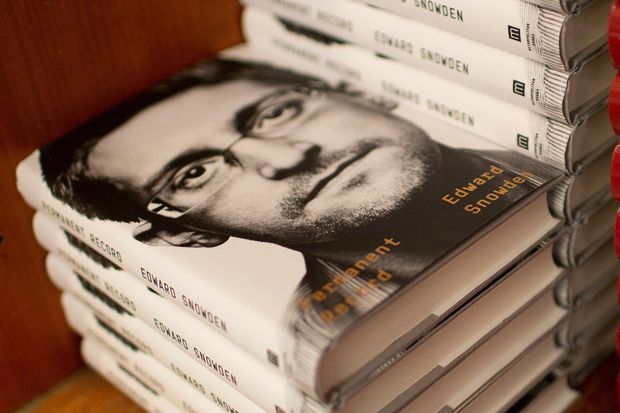
The United States government on Tuesday filed a civil lawsuit against Edward Snowden, the National Security Agency (NSA) whistleblower, over the publication this week of his memoir.
Snowden, the suit contends, “published a book entitled Permanent Record in violation of the non-disclosure agreements he signed with both CIA and NSA”.
The lawsuit alleges that Snowden published his book, Permanent Record, without submitting it to the agencies for pre-publication review, “in violation of his express obligations under the agreements he signed”.
Additionally, the lawsuit alleges that Snowden has given public speeches on intelligence-related matters, “also in violation of his non-disclosure agreements”.
In 2013, Snowden leaked top secret documents on global surveillance programmes run by American and British spy agencies to media outlets including the Guardian. The Guardian and the Washington Post shared a Pulitzer prize for the story.
Snowden is currently living in Moscow. In an interview with the Guardian to mark the publication of his book, he discussed a life spent communicating with supporters in the US by computer. He said he had detected a softening in public hostility towards him.
“We live in a better, freer and safer world because of the revelations of mass surveillance,” he said.
Snowden also said he was reconciled to being in Russia for years and was planning his future with that in mind. He married his partner, Lindsay Mills, in a Russian courthouse two years ago.
If the US government were to get its way, they might not get to enjoy the proceeds of his debut in print.
In a statement on Tuesday, the eastern district of Virginia said: “The United States’ lawsuit does not seek to stop or restrict the publication or distribution of Permanent Record.
“Rather, under well-established supreme court precedent …the government seeks to recover all proceeds earned by Snowden because of his failure to submit his publication for pre-publication review in violation of his alleged contractual and fiduciary obligations.”
The lawsuit also names as nominal defendants the corporate entities involved in publishing Snowden’s book. The US is suing the publisher, Henry Holt and Company, solely to ensure that no funds are transferred to Snowden, or at his direction, while the court resolves the claims.
“Intelligence information should protect our nation, not provide personal profit,” said G Zachary Terwilliger, the US attorney for the eastern district of Virginia. “This lawsuit will ensure that Edward Snowden receives no monetary benefits from breaching the trust placed in him.”
The lawsuit is separate from the criminal charges brought against Snowden, who the government has accused of violating the Espionage Act, for his alleged disclosures of classified information.
In his Guardian interview, he neither confirmed nor denied a detail from Oliver Stone’s 2016 film Snowden, a dramatization of his story which showed him, played by Joseph Gordon-Levitt, smuggling secrets on a memory card stuck to a Rubik’s cube.
“A Rubik’s cube can be very useful and functions as a distraction device and also functions as a concealment device,” he said.
He also discussed life as an NSA contractor, saying that in 21st-century intelligence agencies, “there are no James Bonds”.
Reviewing Snowden’s book, which also contains excerpts from a diary kept by Mills, the Guardian head of investigations, Nick Hopkins, wrote: “His account of the experiences that led him to take momentous decisions, along with the details he gives of his family background, serve as a robust defence against accusations that he is a traitor.
“It also offers a reminder that his disclosures of mass surveillance and bulk collection of personal information are as relevant now as they were in 2013. More so, he argues, given that private companies have become the new data behemoths.”
In its statement announcing its lawsuit, the eastern district of Virginia advised: “This lawsuit is a civil action and based solely on Snowden’s failure to comply with the clear pre-publication review obligations included in his signed non-disclosure agreements.
“This matter is being handled by the US attorney’s office for the eastern district of Virginia and the Department of Justice’s civil division.”
In Russia, Snowden remains for the moment beyond the long arm of the law.
All Rights Reserved for Tom McCarthy
 Productivity Hub