

It was just before closing time at a Verizon store in Bushwick, New York last May when I burst through the door, sweaty and exasperated. I had just sprinted—
okay I walked, but briskly—from another Verizon outlet a few blocks away in the hopes I’d make it before they closed shop for the night. I was looking for a SIM card that would fit a refurbished 2012 Samsung Galaxy S3 that I had recently purchased on eBay, but the previous three Verizon stores I visited didn’t have any chips that would fit such an old model. When I explained my predicament to the salesperson,
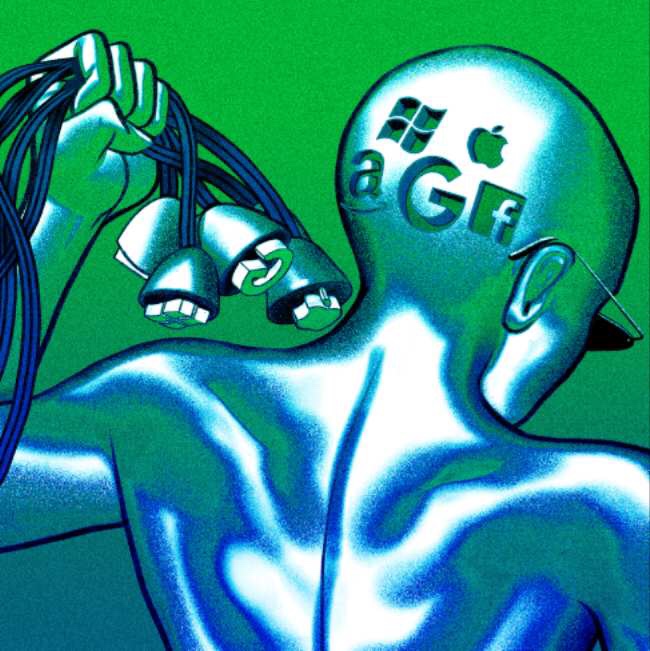
he laughed in my face. “You want to switch from you current phone to an… S3?” he asked incredulously. I explained my situation. I was about to embark on a month without intentionally using any services or products produced by the so-called “Big Five” tech companies: Amazon, Apple, Facebook, Google, and Microsoft.
At that point I had found adequate, open source replacements for most of the services offered by these companies, but ditching the Android OS, which is developed by Google, was proving difficult. Most of the tech I use on a day-to-day basis is pretty utilitarian. At the time I was using a cheap ASUS laptop at work and a homebrew PC at my apartment. My phone was a Verizon-specific version of the Samsung Galaxy J3, a 2016 model that cost a little over $100 new.
They weren’t fancy, but they’ve reliably met most of my needs for years. For the past week and a half I had spent most of my evenings trying to port an independent mobile OS called Sailfish onto my phone without any luck. As it turned out, Verizon had locked the bootloader on my phone model, which is so obscure that no one in the vibrant Android hacking community had dedicated much time to figuring out a workaround. If I wanted to use Sailfish,
I was going to have to get a different phone. I remembered using a Galaxy S3 while living in India a few years ago and liking it well enough. I ultimately decided to go with that model after finding extensive documentation online from others who had had success porting unofficial operating systems onto their phones. So two days and $20-plus-shipping later, I was in possession of a surprisingly new-looking Verizon Galaxy S3. The only thing that remained to do before loading Sailfish onto the device was to find a SIM card that fit. SIM cards come in three different sizes—standard, micro,
and nano—and my nano SIM wouldn’t fit in the S3’s micro SIM port. By the time I explained all this to the Verizon employee, he had found a SIM card that would work. As he navigated the Android setup menu he asked me if I wanted him to link my Google account to the phone. “Oh that’s right,” he said, looking up from the phone and laughing. “Sorry, it’s just a habit.” I could hardly blame him for the slipup.
I’m probably the only person who has ever come into the store who didn’t want to synchronize the Google services they use with their phone. It’d be senseless to resist that kind of convenience and Google knows this, which is why Android prompts you to enter your Google credentials before you’ve even reached the phone’s dashboard for the first time. But what I wanted to know is whether there was another way. Want a more in-depth explanation of why you might want to quit the Big Five? Check out my introductory blog post on how this experiment came about By now, it’s common knowledge that Google, Facebook, and Amazon are harvesting as much of our personal data as they can get their hands on to feed us targeted ads, train artificial intelligence, and sell us things before we know we need them. The results of this ruthless data-driven hypercapitalism speak for themselves: Today,
the Big Five tech companies are worth a combined total of $3 trillion dollars. When I started my month without the Big Five in May, Google’s parent company Alphabet, Amazon, and Apple were racing to be the first company in history with stock worth $1 trillion. In August, Apple became the first to reach this milestone and just a few weeks later Amazon’s market cap also briefly passed $1 trillion.
With the exception of Microsoft and Apple, these fortunes were not built by selling wildly popular products, but by collecting massive amounts of user data in order to more effectively sell us stuff. At the same time, this data has also been abused to swing elections and abet state surveillance. For most of us, giving away our data was seen as the price of convenience—Google and Facebook are “free” to use, after all.
Although Amazon now sells its own products, its rapid growth was fueled by selling other people’s products. This gave the company unprecedented access to consumer habits and data, which it used to spin out its own consumer goods brands and gain invaluable experience in logistics and web hosting.
Both its in-house consumer brands and Amazon Web Services are now core parts of Amazon. The widespread adoption of Microsoft and Apple products over the past 40 years, meanwhile, was no accident, but the result of monopoly-focused business tactics. The end result was that their products appear to be a natural default. You’re either a Mac person or a Windows person and you stick to your brand because that’s the way it’s always been. As the open internet was swallowed whole by the megacorporations of Silicon Valley, however, a revolution was occurring in free,
open source software (FOSS). Although FOSS can trace its roots back to the crew working at MIT’s artificial intelligence laboratory in the early 1980s, it broke into the mainstream in a big way largely due to the creation of Linux, an open operating system developed in the early 90s. These days there’s a galaxy of free and open source software that offers adequate alternatives to most Big Five services, and much of it is powered by Linux. In fact, a lot of the Big Five services you use on a daily basis are probably also based on Linux or open source software that has had some proprietary code grafted on top of it before it was repackaged and sold back to you.
My goal with going a month without the Big Five was to see if I could rely solely on open source or independent software without compromising what I was able to accomplish with proprietary code. Basically, could I live my normal life with open source alternatives? Going into the experiment,
I realized that there was a good chance I’d come crawling back to some of the Big Five services when it was over. Yet as I discovered over the four weeks, switching to independent alternatives didn’t negatively affect most parts of my life, but it did take a little getting used to. Before diving into the nitty gritty of what worked and what didn’t, however, let me explain the limits of the experiment. LIMITATIONS After announcing my intention to relinquish Big Five services for a month,
People On The Internet pointed out that my experiment would fail because I would almost certainly visit a website hosted by Amazon’s cloud service at some point, thereby indirectly putting money into Jeff Bezos’s pocket. This is, of course, true. Amazon Web Services hosts a number of popular sites that I use on a regular basis, such as Netflix, Reddit, Spotify, SoundCloud, and Yelp,
all of which I visited at least once during the month. Unfortunately, avoiding this kind of indirect support of Big Five through their back-end services will become even more difficult to avoid in the future. For example,
Google is beginning to lay its own undersea internet cables, creating the infrastructure for totally networked homes, and developing self-driving car services. Microsoft is aggressively pursuing cloud computing platforms and recently acquired GitHub, a code repository I frequently use while teaching myself how to program.
Amazon moved into the space data business and is also working on networking your home with devices like Alexa, and Facebook still controls how much of the world communicates through its website, Instagram, and WhatsApp.
Yet even if I did scrupulously avoid visiting sites hosted on Amazon Web Services, the experiment was designed to be temporary. This meant that rather than shutting down my work Gmail accounts,
I had them forward my email to an alternative email provider that I would then use to send and receive emails. There were also inevitably important files that I neglected to transfer from my Google Drive to an alternative hosting service when I was preparing for the experiment,
so I had to log in to my Google account to retrieve those files and move them over. Or there were times when I was attempting to change a YouTube link to a HookTube link and accidentally landed on YouTube. I don’t think the handful of lapses alluded to above undercut the spirit of the experiment, however, since I wasn’t intentionally using any services offered by the Big Five.
If I were permanently planning to leave the Big Five I would have transferred all my files from Google Drive, deleted my Gmail accounts, and so on.
So with these experimental limitations in mind, I present the Motherboard Guide to Quitting the Big Five, based on my own experience in May 2018. THE MOTHERBOARD GUIDE TO QUITTING THE BIG FIVE HOW TO QUIT FACEBOOK My experiment in leaving the Big Five arguably began back in March,
when I deleted my Facebook account in the wake of the Cambridge Analytica scandal. Of all the companies I abandoned for this experiment, Facebook and its subsidiaries were by far the easiest. I have tried and failed to start an Instagram account several times over the years. I find Instagram unbelievably boring and I’ve come to terms with the fact that I’ll never understand its already large, and still growing, appeal.
Quitting WhatsApp was more difficult since I used it to keep in touch with my friends abroad, many of whom live in countries where WhatsApp is the default communication tool. With friends and family in the US, I switched over to the encrypted chat app Telegram or just stuck to normal SMS and email. As I soon learned, the ideal messaging platform doesn’t exist. If security is your thing,
WhatsApp, Messenger, Signal, and Telegram all have their flaws and all offer comparable services. The main advantage of WhatsApp is that nearly a quarter of the world already uses it. I have been off Facebook for a few months now and my only regret is that I didn’t leave sooner. Although there is admittedly something of a phantom-limb effect right after leaving—pulling out my phone in response to imaginary pings from Messenger or reflexively navigating to the Facebook login page only to realize I no longer had a profile—the feeling that I was always missing something quickly subsided.
I go out with friends and attend events just as much as I did before. I have no qualms about missing events that I would’ve received a mass Facebook invite to because now I live in blissful ignorance of their occurrence. Contrary to my expectations, my FOMO is at its lowest point in years. Admittedly, leaving Facebook is a privilege.
In many places, Facebook and Messenger are people’s only links to the outside world, or people may depend on Facebook to run their business. It can also make it challenging for people to contact you if you leave. Although I made a point of collecting contact information from my friends before I deleted my account, there were inevitably some I forgot. During my month without the Big Five,
I received an email from an Argentinian friend I hadn’t seen in years who was passing through New York. When we met for dinner, he mentioned how hard I had been to track down without Facebook. Fortunately, I’ve listed my email publicly on my website and still had a Twitter profile at that point, so he was able to find an alternative method of contacting me. But for people who don’t work in industries where it’s normal to make your email public or to have a personal website,
these types of missed connections are bound to happen. As for the actual process of deleting your Facebook profile, it’s pretty simple.
I’ve covered the process in detail in another article, but there are a few points you’ll want to consider before taking the plunge. If you’re the type of person who signs up for other apps such as Tinder or Airbnb with your Facebook account, then deleting your Facebook profile is going to be way more of a pain in the ass because you’re going to have to switch all those accounts over to an email login first.
Second, if you have hundreds of photo albums dating back to 2008 that you want to save, be prepared to spend a few hours scraping them off of Facebook. (There are scripts that help with this, but I didn’t find any of them to be that efficient.) Other than that, there’s a button on Facebook that will allow you to download all your data in one fell swoop. It includes every like, comment, and event invite from the past decade so you can cherish these internet minutiae until you grow old and die.
Read More: Delete All Your Apps There are a number of legitimate reasons you might want to consider leaving Facebook. In my case, I left due to my discomfort with the idea that I was giving away huge amounts of intensely personal data to a company that had a history of mishandling its users’ information.
I was also getting tired of wasting so much time endlessly scrolling through status updates from people whom I hadn’t seen or talked to for years. I had managed to convince myself that clicking “like” on digital simulacra of people’s lives was socializing and, to borrow Mark Zuckerberg’s favorite word, being part of a “community.” There’s no doubt that humans are social creatures and that human interaction is a critical part of an individual’s wellbeing.
How strange, then, that a mounting body of evidence shows that reducing social media use actually decreases loneliness and feelings of unhappiness. To make matters worse, sometimes Facebook makes us unhappy on purpose.
But even if you have more free time than you know what to do with and don’t mind forking over your data to a multi-billion dollar company that just “runs ads,” you might consider ditching Facebook because it is a breeding ground for disinformation. In the past three years, evidence has emerged that Facebook was a primary vector for sowing political discord in the United States and, so far, Zuckerberg hasn’t demonstrated that his company has the faintest idea of how to stop it.
Maybe one day it will figure out an effective filter for fake news, but until then, there’s a good chance that meme your racist uncle just posted was generated by a Russian bot. Read More: The Impossible Job: Inside Facebook’s Struggle to Moderate 2 Billion People During Zuckerberg’s testimony before the US Congress in April, Senator Lindsey Graham asked him point blank whether Facebook was a monopoly. Zuckerberg danced around the question and was ultimately unable to provide an example of alternative services offering a similar product to Facebook.
Although there are lots of alternative social media platforms out there, none of them are used by half the world’s population, which is exactly what makes Facebook so valuable. Still, if you want to keep social media in your life, you might want to use an alternative platform, such as Mastodon (a decentralized Twitter imitator) or Ello (a privacy-oriented, ad-free Facebook alternative).
You won’t find anyone you know on there, probably, but at least your social media fix won’t come at the cost of your privacy. HOW TO QUIT APPLE I’ve only owned two Apple products in my life. One was an old 120 gigabyte iPod classic that I still miss dearly. The other was an iPhone 4 that I got in 2010 and had for a year and a half before I switched to Android and never looked back.
Since I didn’t have any Apple products to relinquish for my monthlong experiment, I used the time for a little introspection on why I dislike Apple products. The main reason is that I was raised using Windows, so I was disincentivized to learn the quirks of a new OS. As I grew older, however, I also found Apple’s “walled-garden” approach to its device ecosystem infuriating. (For many people, however, this closed ecosystem and interoperability between Apple devices is exactly what makes its products attractive.) Apple’s obsession with total control is perhaps best exemplified by the release of iPhone 7 in 2016, which got rid of the ubiquitous headphone jack that has been used by literally every other digital device since forever and replaced it with a proprietary dongle.
This was an affront to Apple’s devout followers, sure, but that didn’t stop the company from selling more than 200 million iPhones last year at around $600 a pop. And yet here we are, years after Apple adopted the dongle, and people are still mourning the loss of the headphone jack. I know why I don’t use Apple, but even after a month of thinking about it, I still couldn’t rationalize why anyone would spend a night sleeping outside an Apple store to get their hands on one of its overpriced products.
People love to justify their purchase of iPhones by appealing to the superior security of iOS compared to Android. But recent updates have significantly closed the security gap between Android phones and iPhones. Unfortunately,
there are no independent studies about what motivates most people to buy Apple phones, but I suspect that security probably wouldn’t top the list. Besides, as the fallout between the FBI and Apple over backdoors reminded us, there’s no such thing as an unhackable device. In fact, there’s a relatively cheap hacking tool that can be used by cops to bypass iPhone encryption.
Even when Apple tried to fix this with a patch, iPhones got hacked again anyway. C’est la vie! Okay, but what about Macs? Apple’s laptops and desktop computers are usually adored for their performance specs and native applications that are geared toward creative types (GarageBand, iMovie, etc.). Apple knows this, which is why a recent commercial campaign for MacBook features artists making art while a Daniel Johnston song called “Story of an Artist” plays in the background. Very subtle.
The thing is, you can build a custom PC that matches or surpasses the technical specs of a high-end Mac without spending $5,000. Despite what you may have heard, building a custom PC is not as hard as it sounds.
It’s basically just an expensive and delicate form of electronic Lego. I don’t have any formal experience in computer science and I was able to build a decent PC with 2 GPUs, 16 gigs of memory, two terabytes of storage, and a quad-core CPU for around $1,000 by using handy tools such as PC Part Picker. My PC has way more power than I’ve ever needed and still costs less than a new MacBook and far less than a Mac desktop.
As for the Mac’s native applications, most of these have fine Linux equivalents. For example, here’s an extensive list of free sound and MIDI software for Linux; Ubuntu Studio is great for most video editing needs; there are even several open source alternatives to Siri. HOW TO QUIT AMAZON Depending on how you look at it, Amazon is either the hardest or the easiest company to quit of the Big Five.
On the one hand, its consumer-facing business is mostly predicated on the idea of convenience, as evidenced by products like the Dash button or Alexa. This should, in principle, make it easy to quit since it would only require going back to the old ways of buying things from an actual brick-and-mortar store or visiting websites that sell specific goods. When I started my experiment,
I had an Amazon Prime account, but really only used Amazon to regularly buy three things: Books, cat food, and cat litter. As someone who exclusively uses public transportation, these items are a pain to buy at a store and transfer to my house because they are large and heavy. Of course I could just order the cat products from another site, but Amazon Prime offers free shipping and the ability to set up recurring automatic orders. Read More: How To Get Amazon Prime for Free for Life During my experiment, however, I was determined to patronize my locally owned pet store since this seemed to be the most antithetical to Amazon’s dominance of all things retail.
Carrying these items the few blocks to my house sucked (a box of cat litter weighs 40 pounds), but what blew even more was the price difference. The same cat food I always buy on Amazon cost more than twice as much at my local pet store. While this was fine for a month, I couldn’t afford this large of an increase in my expenses in the long term. My best bet, then, would be to still buy the pet items I needed online from websites such as Chewy, which still provide most of the convenience offered by Amazon. It wasn’t convenience alone that made Amazon into the behemoth it is today—there were plenty of online book retailers around when Amazon hit the scene in 1994.
What made Amazon successful was that its catalog included books not carried by other (online) bookstores. Over the past two decades, it has expanded this logic to every type of consumer good and this is precisely what makes “the everything store” so difficult to quit. Whereas a brick-and-mortar store can only carry a finite inventory, Amazon’s inventory is effectively limitless. This combination of infinite selection and total convenience is exactly the type of selling point that appeals to America’s workforce, which is increasingly strapped for both time and money.
For people living in rural areas or with disabilities, Amazon’s rapid delivery services can also be a lifeline. I am able-bodied and live in one of the largest cities in the world, so quitting Amazon is arguably a privilege.
I didn’t mind calling my local bookstore to ask it to order a particular title or popping into the local pet store every few weeks if that’s what it took to cut the company from my life. Then one day I was making a recipe that called for pine nuts, only to discover that none of the three grocery stores in my neighborhood carried them. The only other grocery store remotely close to me was Whole Foods, which was recently acquired by Amazon and definitely carried pine nuts.
So I caved, dear reader, and bought some overpriced seeds from an Amazon subsidiary. Although shopping local or going to other online stores is an option for quitting Amazon, some of its other subsidiaries are far more difficult to replace because they are unique. I don’t game, but if I did it would be hard to find an adequate replacement for Twitch because so many gamers already use it.
Likewise, the Internet Movie Database for movie facts and Goodreads for book reviews are two online destinations for which there isn’t an adequate alternative and are basically the go-to sites for their respective domains. Finally, as mentioned earlier, many major websites such as Netflix and Spotify run on Amazon Web Services, so if you use these services you’re also indirectly supporting Amazon.
Nevertheless, there are plenty of good reasons to limit your patronage of Amazon and its subsidiaries. For starters, Amazon has become notorious for its mistreatment of workers. A 2015 New York Times expose detailed the grueling expectations placed on Amazon’s white collar workers, and story after story after story keeps bubbling up that details the inhumane conditions faced by Amazon’s warehouse employees.
You may also take issue with Amazon’s development of facial recognition software that is used for predictive policing and the company’s support of similar products made by companies such as Palantir that use its cloud hosting service.
Even if Amazon’s Echo and Dot are ostensibly benign, they are also liable to be hacked and turned into spy devices. Finally, Amazon has developed a reputation for steamrolling local economies and may end up killing over 2 million jobs as it increases its dominance over traditional retail and other market sectors.
HOW TO QUIT MICROSOFT I have used Microsoft’s operating system for as long as I can remember. My family’s first computer ran Windows 95, but the first experience I can recall with a computer was Windows 98 and the boot theme must’ve imprinted itself on my impressionable, 5-year-old brain because I’ve exclusively used Windows ever since. The Vista and XP years were rough,
All Rights reserved for Daniel Operhaus
 Productivity Hub
I found this an interesting article but very long and hard to read as each topic was not separated by a separate heading.
LikeLike
agreed, there is mistake that repeated some articles i will correct soon, thank you so much for comment, please let me know if you see something need to change
LikeLiked by 1 person